Moz Q&A is closed.
After more than 13 years, and tens of thousands of questions, Moz Q&A closed on 12th December 2024. Whilst we’re not completely removing the content - many posts will still be possible to view - we have locked both new posts and new replies. More details here.
Should I "no-index" two exact pages on Google results?
-
Hello everyone,
I recently started a new wordpress website and created a static homepage.
I noticed that on Google search results, there are two different URLs landing on same content page.
I've attached an image to explain what I saw.
Should I "no-index" the page url?
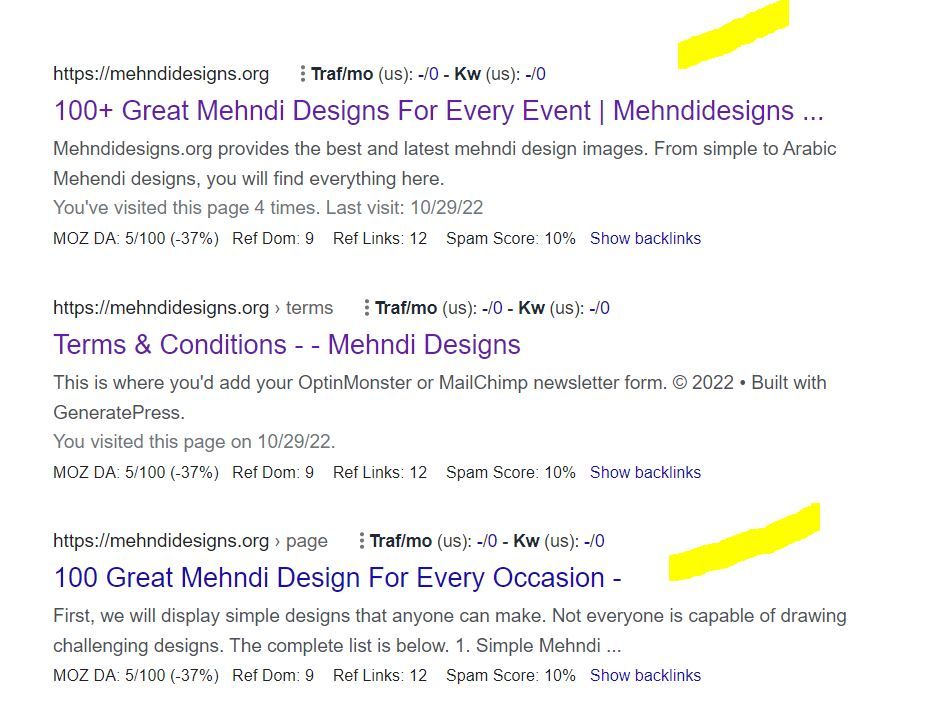
In this picture, the first result is the homepage and I try to rank for that page. The last result is landing on same content with different URL.
So, should I no-index last result as shown in image?
-
In any SEO plugin, you can go to edit the secondary article and in canonical URL you put the link to the home page.
-
@amanda5964 You can use canonical meta tag to tell google that those are the exact same pages. Google will index one of them which google choose best for the SERP.
-
Hi @amanda5964 actually could I ask if there is a reason for having these identical pages? You might want to consider simply combining the pages - i.e. deleting your sub page and redirecting to home if the content is identical.
-
I would not no-index. Typically it is more effective to use a canonical link from the secondary content to the main page you want the traffic directed to.
Got a burning SEO question?
Subscribe to Moz Pro to gain full access to Q&A, answer questions, and ask your own.
Browse Questions
Explore more categories
-
Moz Tools
Chat with the community about the Moz tools.
-
SEO Tactics
Discuss the SEO process with fellow marketers
-
Community
Discuss industry events, jobs, and news!
-
Digital Marketing
Chat about tactics outside of SEO
-
Research & Trends
Dive into research and trends in the search industry.
-
Support
Connect on product support and feature requests.
Related Questions
-
Who is the best SEO expert in the World?
Hey everyone, i am creating a blog post on Top SEO Experts in the World. I need your recommendation who is in the top 10 list? Your suggestions is highly appreciated for me. Thanks!
International SEO | | gxpl090 -
Staging website got indexed by google
Our staging website got indexed by google and now MOZ is showing all inbound links from staging site, how should i remove those links and make it no index. Note- we already added Meta NOINDEX in head tag
Intermediate & Advanced SEO | | Asmi-Ta0 -
Unsolved Using NoIndex Tag instead of 410 Gone Code on Discontinued products?
Hello everyone, I am very new to SEO and I wanted to get some input & second opinions on a workaround I am planning to implement on our Shopify store. Any suggestions, thoughts, or insight you have are welcome & appreciated! For those who aren't aware, Shopify as a platform doesn't allow us to send a 410 Gone Code/Error under any circumstance. When you delete or archive a product/page, it becomes unavailable on the storefront. Unfortunately, the only thing Shopify natively allows me to do is set up a 301 redirect. So when we are forced to discontinue a product, customers currently get a 404 error when trying to go to that old URL. My planned workaround is to automatically detect when a product has been discontinued and add the NoIndex meta tag to the product page. The product page will stay up but be unavailable for purchase. I am also adjusting the LD+JSON to list the products availability as Discontinued instead of InStock/OutOfStock.
Technical SEO | | BakeryTech
Then I let the page sit for a few months so that crawlers have a chance to recrawl and remove the page from their indexes. I think that is how that works?
Once 3 or 6 months have passed, I plan on archiving the product followed by setting up a 301 redirect pointing to our internal search results page. The redirect will send the to search with a query aimed towards similar products. That should prevent people with open tabs, bookmarks and direct links to that page from receiving a 404 error. I do have Google Search Console setup and integrated with our site, but manually telling google to remove a page obviously only impacts their index. Will this work the way I think it will?
Will search engines remove the page from their indexes if I add the NoIndex meta tag after they have already been index?
Is there a better way I should implement this? P.S. For those wondering why I am not disallowing the page URL to the Robots.txt, Shopify won't allow me to call collection or product data from within the template that assembles the Robots.txt. So I can't automatically add product URLs to the list.0 -
Ranking going south
Hi - I have a site Simply Stairlifts and I don't understand it but I've followed all the SEO processes of cleaning the site and building links, but ranking just keeps falling - any advise would be very gratefully received 👍 .
SEO Tactics | | Naju2310 -
Footer backlink for/to Web Design Agency
I read some old (10+ years) information on whether footer backlinks from the websites that design agencies build are seen as spammy and potentially cause a negative effect. We have over 150 websites that we have built over the last few years, all with sitewide footer backlinks back to our homepage (designed and managed by COMPANY NAME). Semrush flags some of the links as potential spammy links. What are the current thoughts on this type of footer backlink? Are we better to have 1 dofollow backlink and the rest of the website nofollow from each domain?
Link Building | | MultiAdE1 -
Why do some URLs for a specific client have "/index.shtml"?
Reviewing our client's URLs for a 301 redirect strategy, we have noticed that many URLs have "/index.shtml." The part we don'd understand is these URLs aren't the homepage and they have multiple folders followed by "/index.shtml" Does anyone happen to know why this may be occurring? Is there any SEO value in keeping the "/index.shtml" in the URL?
Technical SEO | | FranFerrara0 -
Investigating a huge spike in indexed pages
I've noticed an enormous spike in pages indexed through WMT in the last week. Now I know WMT can be a bit (OK, a lot) off base in its reporting but this was pretty hard to explain. See, we're in the middle of a huge campaign against dupe content and we've put a number of measures in place to fight it. For example: Implemented a strong canonicalization effort NOINDEX'd content we know to be duplicate programatically Are currently fixing true duplicate content issues through rewriting titles, desc etc. So I was pretty surprised to see the blow-up. Any ideas as to what else might cause such a counter intuitive trend? Has anyone else see Google do something that suddenly gloms onto a bunch of phantom pages?
Technical SEO | | farbeseo0 -
De-indexing millions of pages - would this work?
Hi all, We run an e-commerce site with a catalogue of around 5 million products. Unfortunately, we have let Googlebot crawl and index tens of millions of search URLs, the majority of which are very thin of content or duplicates of other URLs. In short: we are in deep. Our bloated Google-index is hampering our real content to rank; Googlebot does not bother crawling our real content (product pages specifically) and hammers the life out of our servers. Since having Googlebot crawl and de-index tens of millions of old URLs would probably take years (?), my plan is this: 301 redirect all old SERP URLs to a new SERP URL. If new URL should not be indexed, add meta robots noindex tag on new URL. When it is evident that Google has indexed most "high quality" new URLs, robots.txt disallow crawling of old SERP URLs. Then directory style remove all old SERP URLs in GWT URL Removal Tool This would be an example of an old URL:
Technical SEO | | TalkInThePark
www.site.com/cgi-bin/weirdapplicationname.cgi?word=bmw&what=1.2&how=2 This would be an example of a new URL:
www.site.com/search?q=bmw&category=cars&color=blue I have to specific questions: Would Google both de-index the old URL and not index the new URL after 301 redirecting the old URL to the new URL (which is noindexed) as described in point 2 above? What risks are associated with removing tens of millions of URLs directory style in GWT URL Removal Tool? I have done this before but then I removed "only" some useless 50 000 "add to cart"-URLs.Google says themselves that you should not remove duplicate/thin content this way and that using this tool tools this way "may cause problems for your site". And yes, these tens of millions of SERP URLs is a result of a faceted navigation/search function let loose all to long.
And no, we cannot wait for Googlebot to crawl all these millions of URLs in order to discover the 301. By then we would be out of business. Best regards,
TalkInThePark0