Moz Q&A is closed.
After more than 13 years, and tens of thousands of questions, Moz Q&A closed on 12th December 2024. Whilst we’re not completely removing the content - many posts will still be possible to view - we have locked both new posts and new replies. More details here.
Found a Typo in URL, what's the best practice to fix it?
-
Wordpress 3.4, Yoast, Multisite
The URL is supposed to be "www.myexample.com/great-site"
but I just found that it's "www.myexample.com/gre-atsite"
It is a relatively new site but we already pointed several internal links to "www.myexample.com/gre-atsite"
What's the best practice to correct this? Which option is more desirable?
1.Creating a new page
I found that Yoast has "301 redirect" option in the Advanced tap
Can I just create a new page(exact same page) and put noindex, nofollow and redirect it to http://www.myexample.com/great-site
OR
2. htacess redirect rule
simply change the URL to http://www.myexample.com/great-site
and update it, and add
Options +FollowSymLinks RewriteEngine On
RewriteCond %{HTTP_HOST} ^http://www.myexample.com/gre-atsite$ [NC]
RewriteRule ^(.*)$ http://www.myexample.com/great-site$1 [R=301,L] -
Thank you Dan!
Wordpress 3.4 did have some redirecting features. but it didn't correct typos

so our solution was just fix the URL, changed all the internal links and used 301 direct using an example here
If anyone facing this problem,
 here is your answer!
 -
Hi
I actually think WordPress now does the redirects and fixes internal links now when you update the permalink. Try just updating it and see if they get fixed. (Although it may not catch internal links you've added within posts etc, just in the main menu).
If WordPress doesn't do this, just change the URL, change all internal links as needed and also use a 301 redirect.
A fast way to look for bad internal links is with Screaming Frog SEO Spider.
Hope that helps!
-Dan
-
Why not just use Redirect 301 /gre-atsites http://www.myexample.com/great-site ?
-
Dont use redirects if you can avoid it, they do not pass all the link juice,
Make the correct page, and fix the internal links. delete the old page.




Browse Questions
Explore more categories
-
Moz Tools
Chat with the community about the Moz tools.
-
SEO Tactics
Discuss the SEO process with fellow marketers
-
Community
Discuss industry events, jobs, and news!
-
Digital Marketing
Chat about tactics outside of SEO
-
Research & Trends
Dive into research and trends in the search industry.
-
Support
Connect on product support and feature requests.
Related Questions
-

Strange URL's for client's site
We just picked up a new client and I've been doing some digging around on their site. They have quite the wide variety of URL's that make for a rather confusing experience. One of the milder examples is their "About" page. Normally I would expect something along the lines of: www.website.com/about I see: www.website.com/default.asp?Page=About I'm typically a graphic designer and know basically nothing about code, but I just assume this has something funky to do with how their website was constructed. I'm assuming this isn't particularly SEO friendly, but it doesn't seem too bad. Until I got to another section of their site. It's a section that logically should look like: www.website.com/training/public-seminars It's: www.website.com/default.asp?Page=MT&Area=Seminars&Sub=MRM Now that's nonsensical to me! Normally if a client has terrible URL's, I'd say let's do some redirects, but I guess I'm a little intimidated by these. Do the URL's have to be structured like this for some reason? Am I missing some important area of coding here? However, the most bizarre example is a link back to their website from yellowpages.com. Where normally I would expect it to lead to their homepage, I get this bizarre-looking thing: http://website1-px.rtrk.com/?utm_source=ReachLocal&utm_medium=PPC&utm_campaign=AssetManagement&reference_id=15&publisher=yellowpages&placement=ypwebsitemip&action_target=listing_website And as you browse through the site, that strange domain stays. For example the About page is now: http://website1-px.rtrk.com/default.asp?Page=About I would try to google this but I have no idea where to even start! What is going on with these links? Will we be able to fix them to something presentable without breaking their website?
Technical SEO | | everestagency0 -

Does Title Tag location in a page's source code matter?
Currently our meta description is on line 8 for our page - http://www.paintball-online.com/Paintball-Guns-And-Markers-0Y.aspx
Technical SEO | | Istoresinc The title tag, however sits below a bunch of code on line 237
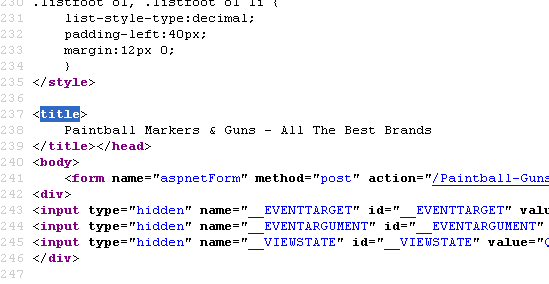 Does the location of the title tag, meta tags, and any structured data have any influence with respect to SEO and search engines? Put another way, could we benefit from moving the title tag up to the top?
I "surfed 'n surfed" and could not find any articles about this.
I would really appreciate any help on this as our site got decimated organically last May and we are looking for any help with SEO.
NIck
0
Does the location of the title tag, meta tags, and any structured data have any influence with respect to SEO and search engines? Put another way, could we benefit from moving the title tag up to the top?
I "surfed 'n surfed" and could not find any articles about this.
I would really appreciate any help on this as our site got decimated organically last May and we are looking for any help with SEO.
NIck
0 -

Is it good practice to still pay for Best of the Web Directory (BOTW) and other similar one's you have to pay for?
I know that paid for links are hit by Google, but in the past these directories were okay. What about now? Thank you.
Technical SEO | | RoxBrock0 -

Image Height/Width attributes, how important are they and should a best practice site include this as std
Hi How important are the image height/width attributes and would you expect a best practice site to have them included ? I hear not having them can slow down a page load time is that correct ? Any other issues from not having them ? I know some re social sharing (i know bufferapp prefers images with h/w attributes to draw into their selection of image options when you post) Most importantly though would you expect them to be intrinsic to sites that have been designed according to best practice guidelines ? Thanks
Technical SEO | | Dan-Lawrence0 -

Is there a way for me to automatically download a website's sitemap.xml every month?
From now on we want to store all our sitemap.xml over the next years. Its a nice archive to have that allows us to analyse how many pages we have on our website and which ones were removed/redirected. Any suggestions? Thanks
Technical SEO | | DeptAgency0 -

Why am I not showing up in the SERP's or Google Local?
I have been trying to optimise the following site for both Google SERP's and Google Local - Pixel Primate The URL has been around for around 3 years now but they just updated the website and launched it in December 2012. I did the on-page optimisation early in January 2013 and Google seems to have indexed the changes, for the home page at least. One major keyword I am targeting for the home page is 'Web Design Leicester'. I understand that the DA is fairly low (24) so this is something I need to improve. However, I've experienced positive results fairly quickly from just on-page optimisation for other sites I have worked on. The site just doesn't seem to be ranking at all for any keywords. Maybe the industry type is just extremely competitve but I find it very strange to not be visible anywhere in the SERPs. The site does not seem to have any penalties as it ranks for 'Pixel Primate' and all pages appear when doing a site: search. Also what's strange is that I set up the Google Local listing years ago but it doesn't appear anywhere in the local listing, not even when I search for it manually. Any suggestions would be appreciated.
Technical SEO | | CWseo0 -

Cloaking? Best Practices Crawling Content Behind Login Box
Hi- I'm helping out a client, who publishes sale information (fashion sales etc.) In order for the client to view the sale details (date, percentage off etc.) they need to register for the site. If I allow google bot to crawl the content, (identify the user agent) but serve up a registration light box to anyone who isn't google would this be considered cloaking? Does anyone know what the best practice for this is? Any help would be greatly appreciated. Thank you, Nopadon
Technical SEO | | nopadon0 -

What is best practice for redirecting "secondary" domain names?
For sites with multiple top-level domains that have been secured for a business or organization, I'm curious as to what is considered best practice for setting up 301 redirects for secondary domains. Is it best to do the 301 redirects at the registrar level, or the hosting level? So that .net, .biz, or other secondary domains funnel visitors to the correct primary/main domain name. I'm looking for the "best practice" answer and want to avoid duplicate content problems, or penalties from the search engines. I'm not trying to game the system with dozens of domain names, simply the handful of domains that are important to the client. I've seen some registrars recommend hosting secondary domains, and doing redirects from the hosting level (and they use meta refresh for "domain forwarding," which I want to avoid). It seems rather wasteful to set up hosting for a secondary domain and then 301 each URL.
Technical SEO | | Scott-Thomas0