Moz Q&A is closed.
After more than 13 years, and tens of thousands of questions, Moz Q&A closed on 12th December 2024. Whilst we’re not completely removing the content - many posts will still be possible to view - we have locked both new posts and new replies. More details here.
How to get search volume in Google's keyword planner
-
I want to know the search volume for ~1000 keywords that I discovered via ubersuggest.
Yesterday I could have done this in 5 minutes, but I can't seem to get it to work in the new Google tool and would love some advice.
When I either upload or copy and paste my list into the tool I can get it to give me search ideas with volume, but it has all the keywords I am uploading as 0 search volume (when I know that is not true and some of them have thousands of searches). I've tried "entering keywords to see how they perform" and also "searching for keyword ideas" (the second just because the first didn't try after my 10 tries)
Any ideas about what I am doing wrong?
Or is this a bug other people have been experiencing? -
That's what I'm doing and isn't working...
But thanks!
-
-
Go to https://adwords.google.com/ko/KeywordPlanner/Home, click "Enter or upload keywords to see how they perform"
-
Copy/paste list or upload a file, set your targeting preferences. Press "Get Search Volume"
-
Click on the "Keyword Ideas" tab, download
Hope that's what you're looking for!
Cheers,
Oleg -
Browse Questions
Explore more categories
-
Moz Tools
Chat with the community about the Moz tools.
-
SEO Tactics
Discuss the SEO process with fellow marketers
-
Community
Discuss industry events, jobs, and news!
-
Digital Marketing
Chat about tactics outside of SEO
-
Research & Trends
Dive into research and trends in the search industry.
-
Support
Connect on product support and feature requests.
Related Questions
-
Inconsistent Keyword Search Volume & Difficulty Across Tools (e.g., Moz, Google Keyword Planner, Ahrefs, Semrush)
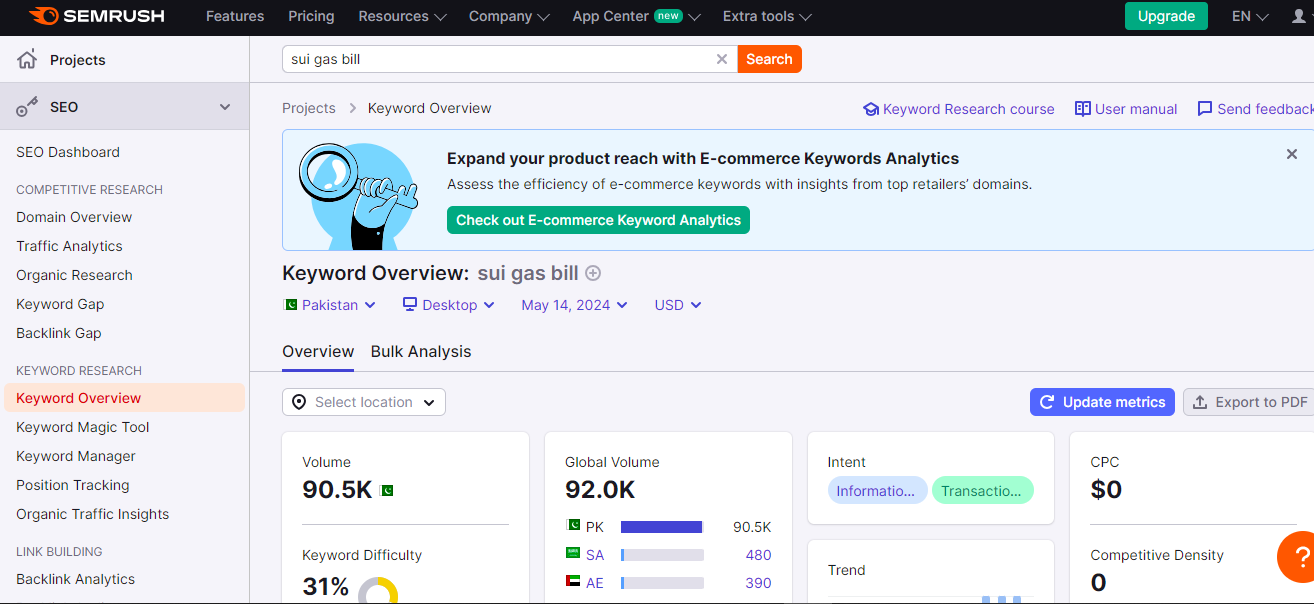
Hi there, Moz Community! I'm reaching out for some guidance on keyword research discrepancies. I'm currently targeting the keyword "sui gas bill" for my blog, sngplbill, which focuses on information related to Sui gas bills. I've used several keyword research tools, including Moz, Google Keyword Planner, Ahrefs, and Semrush, and each platform provides different search volume and keyword difficulty scores: Moz: No search volume data, Keyword Difficulty (KD) 24
Keyword Research | | Faizali.786
Google Keyword Planner: Search volume 100k-1M, Difficulty (Low)
Semrush: Search volume 90k, KD 31
Ahrefs: KD 1 (Very Easy)
These varying results are causing some confusion. Ideally, I'd like to understand which platform offers the most reliable data for search volume and keyword difficulty. Here are some additional details that might be helpful: My target location: Pakistan My Questions: What factors might contribute to these discrepancies in keyword data across different tools?
Considering my niche (Sui gas bill information in Pakistan), which platform would you recommend for the most accurate search volume and keyword difficulty estimates?
Are there any additional factors to consider beyond search volume and keyword difficulty when selecting keywords for content strategy?
Any insights you can provide would be greatly appreciated!
Capture sui gas bill semrush.PNG Capture moz sui gas bill.PNG Capture gkp sui gas bill.PNG Capture ahref sui gas bill.PNG
Thanks,0 -
How do I do keyword research when search volume is unknown
Hi Mozzers! I do a lot of work in niche areas, and one issue I often confront in keyword research is unknown search volume. That is, I'll be doing keyword research in Keyword Explorer or Gooogle Search Console, and for the most relevant keywords, I find either very low search volumes, null search volumes, or "Data not available." How do I make good keyword planning decisions when I can't find good data for search volume? Thanks for sharing your thoughts. Andy
Keyword Research | | AndyKubrin0 -
Is it a bad idea to hyphenate keywords?
Hello, my understanding was that Google reads hyphens in keywords as spaces, but if that's accurate how come keywords with hyphens that I research with Keyword Explorer — for instance, hospital-acquired infections — rank lower when I include the hyphen? If the hyphen hurts SEO, do I have to remove them all from the blog or page in question? Removing hyphens means a blog or page will have punctuation errors, which is irritating to an editor, but I don't want to sacrifice the effectiveness of keywords, either. Thanks, in advance, for your response!
Keyword Research | | SallieJ0 -
How many keywords do you recommend tracking?
I am working through thousands of organic keywords and would like to create a list of core keywords. I want the list to be small enough that we can really go after these keywords and track progress. I work for a B2B software company. I am thinking between 20-30 but I would love to hear any tips, opinions and recommendations! Thank you!
Keyword Research | | NikCall0 -
Has the keyword planner search volume metric gone crazy?
I use the search volume found in keyword planner to score and weight my keywords in a similar way as Rand showed us in this WBF. This week I've found that in many cases suddenly the singular and plural version of the keyword have the same search volume. This seems crazy to me as singular and plural is not the same, the intent is different but more importantly they behave very differently from each other when looking at their track record in Adwords (impressions, clicks, conversions, CTR, CVR etc...all different). For example, here's a screenshot of 4 keywords (singular and plural versions of 2 phrases) with search volume captured a couple of months ago. Now here's another screenshot of the same keywords taken from Keyword planner today. Any ideas why this would be happening? Does it makes sense to you? It just seems buggy to me. Thanks!
Keyword Research | | E_F0 -
'And' vs '&'
Hi everyone This question has been running through my mind since a few days now. Does Google recognise 'and' / '&' as the same? Say for example my website url is: appleandorange.com and my keyword for my company is Apple & Orange. If i Focus on Apple & Orange for on-page SEO will google also recognise apple and orange ? Or will I have to on-page SEO seperately for Apple and orange? So for instance if I keep focusing on Apple & Orange will my website appleandorange.com appear on google? Thanks in advance
Keyword Research | | u_rauf920 -
Branded vs Generic keywords - is Google treating their rank equaly!?
Several times I have noticed that website receiving sort of a rankings drop penalty for certain wrongly built on-page strategies that involves keyword stuffing, wrong keyword density(too much) etc. The question is - how you guys think - is branded keywords receiving the same treatment from Google then generic ones? And here is why - for one popular brand I see that they ranking for their brand keyword very high(1th) but keyword density is awful - more then 10%. So, my guess is - if this keyword density you would apply for generic keyword you will end up nowhere to be found for it! Is that could be truth? Any experiments info about that? thanks and regards, Jungles
Keyword Research | | Jungles0 -
Search Terms with Apostrophes
In doing keyword research I discovered that the Google Adwords Tools returns results with a space in search terms where an apostrophe should be. For example: Searching for 'mens fashion' or 'men's fashion' will return keyword ideas like 'men s fashion trends', 'men s fashion styles'. Same thing happens if yous search for '50s fashion' or 'mens suits'. Not only that but if you search for 'men s fashion' in the adwords tool you get 14,800 exact matches! Who would you use that term? And if you do search for it in Google, it will auto correct to 'men's fashion'. If you know the answer to what a term like 'men s fashion' signifies, you can skip the rest of this post and answer my question (thanks!). If not, here's what I did to try and figure it out - but I'm stuck and I need your help. First off, I did a search for all 3 terms: (mens fashion, men's fashion and men s fashion) in the adwords tool. The tool responded with different numbers for each, with 'men s fashion' far exceeding 'men's fashion'. See image 1 I did a search for each of the three terms in Google. The top 10 results for each were different. See image 2 Google reads 'men s fashion' as 'men's fashion'. I know that because: Google says 'showing result's for men's fashion' (obvious!) Google instant lists terms beginning with 'men's fashion...' See image 3 Related searches are identical for those two but not for 'mens fashion'. But it's not completely the same since as I mentioned you get different results, and the number of results found are different as well. So that brings me back to my question: When the tool says that 28 people search for [men's fashion] and 14,800 search for [men s fashion]. What on earth does it mean? bknQU tNKo7 C0P7S
Keyword Research | | 5225Marketing2