Moz Q&A is closed.
After more than 13 years, and tens of thousands of questions, Moz Q&A closed on 12th December 2024. Whilst we’re not completely removing the content - many posts will still be possible to view - we have locked both new posts and new replies. More details here.
Why is Google replacing our title tags with URLs in SERP?
-
Hey guys,
We've noticed that Google is replacing a lot of our title tags with URLs in SERP. As far as we know, this has been happening for the last month or so and we can't seem to figure out why.
I've attached a screenshot for your reference.
What we know:
- depending on the search query, the title tag may or may not be replaced.
- this doesn't seem to have any connection to the relevance of the title tag vs the url.
- results are persistent on desktop and mobile.
- the length of the title tag doesn't seem to correlate with the replacement.
- the replacement is happening at mass, to dozens of pages.
Any ideas as to why this may be happening?
Thanks in advance,
Peter -
Hi Jesse,
Looking through our change log, it seems like our marketing team removed "| Mobify" from all title tags on July 2nd.
They did it because "Mobify" is already in the domain name and is generally mentioned on all pages, so they didn't feel like it was necessary to call it out in the title tags too.
I'm going to add it back and see what happens. Will keep you posted!
Best,
Peter -
Hi again Peter,
That is very interesting and I see your confusion here. I repeated the same test and was given the same results without your brand name in query.. Still when Google is listing the title they are listing your brand name.
It seems to me that they really want your brand name to show in this title. Why? I'm not entirely sure. But that's what they're adding to your title here..
Try shortening your title on that page by a word or two and adding a pipe (|) and "Mobify." Make that your test page for this issue and see what Google does with it when the change populates. I have a funny feeling it might pull your full title at that point.
Most sites out there try to drag their domain/brand into each page title anyway. You can call it "best practice" or just a "funny habit" but I feel like this is what Google is looking for with your site.
I'm incredibly curious, so if you don't mind trying this out and reporting back I would be greatly appreciative.
Thanks and good luck!
-
Thanks for taking your time to answer, Jesse!
Your hypothesis makes total sense, and I was hoping that was the case. Unfortunately, under further inspection, I'm still not sure.
Check this out. We have a page with a title tag "Retail App Engine: The Next Step in Your Mobile Commerce Strategy". I've attached a screenshot of what happens when I search for "Retail App Engine." I don't see why Google would not like our title tag in this case.
If you have any further ideas, I would really appreciate them!
-
If I may chime in, I'm guessing that the search was actually "site:mobify.com mobify" (without quotes). Whether that's right or wrong, however, I know does't answer the question. However, when you do that search, you notice that there are numerous examples of similar occurrences. In each case, the titles are quite long. This situation has been noticed before and there was even a post about it on the Moz blog by Ruth Burr Reedy. In that post, Ruth tracked down a likely possible cause as being that the title provided by the author is too long and because of that Google replaces it with it's best algorithmic alternative.
Peter, try shortening the titles and see if that solves your problem.
-
This was intriguing to me so I dug in a little and I have an initial theory here:
In the example you provided you seem to be searching with your brand name only. "Mobify" is bolded telling me that was a searched keyword.
The title tag for the page in question reads: "25 Top Design Upgrades to Make Your Mobile Revenue Skyrocket [SlideShare]"
My bet is that because you do not have the brand name in your title tag, Google is looking to display something that does carry this particular keyword. In this case it is looking for something with the word "Mobify" in it and finding it in the URL. If you take out the SlideShare portion of your title and replace it with "| Mobify" my guess is this problem will go away.
Look at the other URLs you are having this problem with and tell me if the brand name is missing from it but present in the searched query.
Let me know if this works!





Browse Questions
Explore more categories
-
Moz Tools
Chat with the community about the Moz tools.
-
SEO Tactics
Discuss the SEO process with fellow marketers
-
Community
Discuss industry events, jobs, and news!
-
Digital Marketing
Chat about tactics outside of SEO
-
Research & Trends
Dive into research and trends in the search industry.
-
Support
Connect on product support and feature requests.
Related Questions
-

What happens when you replace a page with a new version that has the same URL?
a new page template was created the plan is to publish the new page (which has the same URL as before) to web and delete the old page that has the URL , will that have an SEO implications ?
Technical SEO | | lina_digital1 -

My Website's Home Page is Missing on Google SERP
Hi All, I have a WordPress website which has about 10-12 pages in total. When I search for the brand name on Google Search, the home page URL isn't appearing on the result pages while the rest of the pages are appearing. There're no issues with the canonicalization or meta titles/descriptions as such. What could possibly the reason behind this aberration? Looking forward to your advice! Cheers
Technical SEO | | ugorayan0 -

Google is shortening many of my title tags although they are already quite concise
Hi, Title tags of our website are being truncated by Google even though they can be very short (sometimes < 40 characters) and with very few capital letters. We would like to understand why. Example: Principal component analysis (pca) in abcde - OurBrand shows up as: Principal component analysis (pca) in abcd... - OurBrand where abcde is the name of a very common software (5 characters), and OurBrand is a 6 characters long string (could be used in either lower case or upper case). Even when removing the brackets around pca, truncation still occurs... Any clue why?
Technical SEO | | trigaudias1 -

SERP Title shows up-with-dashes
Occasionally I see the our 'listings' on Google where the Title line shows up with dashes... like sony-professional-hard-drive - TapeandMedia.com It appears to be the URL shortened and rehashed. This example was after I searched for "Sony PSZ-HA1T" without the quotes. The title for this page is <title></span><span class="html-tag">Sony 1TB Professional Portable External Hard Disk Drive (PSZ-HA1T)</span><span class="html-tag"></title> and the url is http://www.tapeandmedia.com/sony-1tb-professional-portable-hard-drive.asp Link to image: http://i.imgur.com/FmvAn6c.jpg Other searches (like "Sony 1tb PSZ-HA1T") yield normal looking SERP Titles Does anyone know why this happens and what I can do to avoid this? FmvAn6c.jpg
Technical SEO | | BWallacejr0 -

Does Title Tag location in a page's source code matter?
Currently our meta description is on line 8 for our page - http://www.paintball-online.com/Paintball-Guns-And-Markers-0Y.aspx
Technical SEO | | Istoresinc The title tag, however sits below a bunch of code on line 237
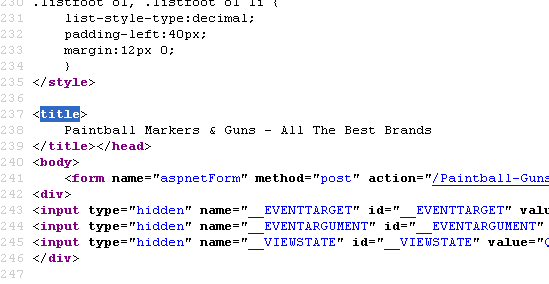 Does the location of the title tag, meta tags, and any structured data have any influence with respect to SEO and search engines? Put another way, could we benefit from moving the title tag up to the top?
I "surfed 'n surfed" and could not find any articles about this.
I would really appreciate any help on this as our site got decimated organically last May and we are looking for any help with SEO.
NIck
0
Does the location of the title tag, meta tags, and any structured data have any influence with respect to SEO and search engines? Put another way, could we benefit from moving the title tag up to the top?
I "surfed 'n surfed" and could not find any articles about this.
I would really appreciate any help on this as our site got decimated organically last May and we are looking for any help with SEO.
NIck
0 -

Google News URL Format
Hi, We are currently redesigning our gaming website (www.totallygn.com) and one of our main goals is to get listed by Google News in future. Looking at the Google News URL requirements "The URL for each article must contain a unique number consisting of at least three digits." How does the above affect SEO structure? I was planning on using a format such as www.totallygn.com/xbox-360/360-reviews/fifa-12-review how would this compare to something like? www.totallygn.com/xbox-360/360-reviews/fifa-12-review234 Thanks in advance for your help
Technical SEO | | WalesDragon0 -

Alt and Title Attributes in Anchor Tags
Does it hurt to use alt and title attributes inside an anchor tag? Example: view my website article
Technical SEO | | donationtown0 -

How do I get Google to display categories instead of the URL in results?
I've seen that for some domains Google will show a nice clickable site heirarchy in place of the actual URL of a search result. See attached for an example. How do I go about achieving this type of results? categorized.png
Technical SEO | | Carlito-2569610