Moz Q&A is closed.
After more than 13 years, and tens of thousands of questions, Moz Q&A closed on 12th December 2024. Whilst we’re not completely removing the content - many posts will still be possible to view - we have locked both new posts and new replies. More details here.
Sitelinks Issue - Different Languages
-
Hey folks,
We run different ccTLD's for revolveclothing.com (revolveclothing.es, revolveclothing.com.br, etc. etc.) and they all have their own WMT/Google Console with their own href lang tags etc.
The problem is this.
https://www.google.fr/#q=revolve+clothing
When you look at the sitelinks, you'll see that one of them (sales page) happens to be in Portuguese on the French site. Can anyone investigate and see why?
-
The Dirk answer points to some potential answers.
Said that, when I click on your SERP's link, I see others sitelinks (just two):
- the first >>> Robes
- the second >>> Вся распродажа.
As Dirk pointed out, your site has detected my IP (quite surely, but maybe it is user agent), and when I click on the second sitelink I see this url: http://www.revolveclothing.es/r/Brands.jsp?aliasURL=sale/all-sale-items/br/54cc7b&&n=s&s=d&c=All+Sale+Items.
The biggest problem, when it comes to IP redirections, is that they are a big problem in terms both of SEO and usability:
- SEO, because googlebot (and others bots) will mostly be redirected to the USA version due to their IPs, even though Google crawls site also from datacenters present in other country (but much less);
- Users, because you are making impossible, for instance, to a Spanish user to see the Spanish site whenever they are not in Spain. And that really sucks and pisses off users.
There's a solution:
-
making the IP redirection just the first time someone click on a link to your site and if that link is not corresponding to the version of the country from were users and bots are clicking;
-
presenting the links to the others country versions of your site, so that:
-
bots will follow those links and discover those versions (but not being redirected again);
-
users are free to go to the version of your site they really need (but not being redirected again if coming from those country selector links).
Said that, it would be better using a system like the one Amazon uses, which consists not forcing a redirection because of IP, but detecting it and launching an alert on-screen, something like: "We see that you are visiting us from [Country X]. Maybe you will prefer visiting [url to user's country site]".
Then, i just checked the hreflang implementation, and it seems it was implemented correctly (at least after a very fast review with Flang).
I tried to search for "Resolve clothing" in Spain incognito and not personalized search, and it shows me the Spanish website and Spanish sitelinks correctly;
I tried the same search from Spain but letting Google consider my user-agent (setup for English in search), and I saw the .com version and English sitelinks (which is fine).
Remember, sitelinks are decided by Goggle and we can only demote them.
To conclude, I think the real reason has to be searched not in a real international SEO issue (but check out the IP redirection), but to a possible and more general indexation problem.
-
If you look at the results on Google fr - I find it more surprising that apart from the first result - all the other results that are shown are coming from the .com version rather than the .fr version. If I search for Revolve cloathing on google.pt - I only get the US results & instagram.
You seem to use a system of ip detection - if you visit the French site from an American ip address you are redirect to the .com version (at least for the desktop version) - check this screenshot from the French site taken with a American ip address: http://www.webpagetest.org/screen_shot.php?test=150930_BN_1DSQ&run=1&cached=0 => this is clearly the US version. Remember that the main googlebot is surfing from a Californian ip - so he will mainly see the US version - there are bots that visit with other ip's but they don't guarantee that these visit with the same frequency & same depth (https://support.google.com/webmasters/answer/6144055?hl=en). This could be the reason of your problem.
On top of that - your HTML is huge - the example page you mention has 13038 lines of HTML code and takes ages to load ( 16sec - http://www.webpagetest.org/result/150930_VJ_1KRP/ ). Size is a whopping 6000KB. Speed score for Google : 39%. You might want to look to that.
Hope this helps,
Dirk
-
Hey Jarred, Which one? http://take.ms/xTPyo My Portugese is terrible these days.




Browse Questions
Explore more categories
-
Moz Tools
Chat with the community about the Moz tools.
-
SEO Tactics
Discuss the SEO process with fellow marketers
-
Community
Discuss industry events, jobs, and news!
-
Digital Marketing
Chat about tactics outside of SEO
-
Research & Trends
Dive into research and trends in the search industry.
-
Support
Connect on product support and feature requests.
Related Questions
-

Unsolved Question about a Screaming Frog crawling issue
Hello, I have a very peculiar question about an issue I'm having when working on a website. It's a WordPress site and I'm using a generic plug in for title and meta updates. When I go to crawl the site through screaming frog, however, there seems to be a hard coded title tag that I can't find anywhere and the plug in updates don't get crawled. If anyone has any suggestions, thatd be great. Thanks!
Technical SEO | | KyleSennikoff0 -

Escort directory page indexing issues
Re; escortdirectory-uk.com, escortdirectory-usa.com, escortdirectory-oz.com.au,
Technical SEO | | ZuricoDrexia
Hi, We are an escort directory with 10 years history. We have multiple locations within the following countries, UK, USA, AUS. Although many of our locations (towns and cities) index on page one of Google, just as many do not. Can anyone give us a clue as to why this may be?0 -

Google serp pagination issue
We are a local real estate company and have landing pages for different communities and cities around our area that display the most recent listings. For example: www.mysite.com/wa/tumwater is our landing page for the city of Tumwater homes for sale. Google has indexed most of our landing pages, but for whatever reason they are displaying either page 2, 3, 4 etc... instead of page 1. Our Roy, WA landing page is another example. www.mysite.com/wa/roy has recently been showing up on page 1 of Google for "Roy WA homes for sale", but now we are much further down and www.mysite.com/wa/roy?start=80 (page 5) is the only page in the serps. (coincidentally we no longer have 5 pages worth of listings for this city, so this link now redirects to www.mysite.com/wa/roy.) We haven't made any major recent changes to the site. Any help would be much appreciated! *You can see what my site is in the attached image... I just don't want this post to show up when someone google's the actual name of the business 🙂 nTTrSMx.jpg C4mhfgh.jpg
Technical SEO | | summithomes0 -

Google SERPs Show Different Title
Hi Guys, Can anyone please help with my situation. My domain is www.greedybins.com.au. I had title setup in every pages differently, and it has been 2 months since I made the changes. I keep checking by using site:www.greedybins.com.au in search. So far, only 1 title that been show correctly in SERPs. I used SEO Yoast before, I changed to All In One SEO Pack plugin, the titles are changing, but still not accurate as I made it. Somehow Google altered it by itself. I have tried fetch and submit sitemap couple times from Google Search Console. Could anyone please advise?
Technical SEO | | ray.soms0 -

I have multiple URLs that redirect to the same website. Is this an issue?
I have multiple URLs that all lead to the same website. Years ago they were purchased and were sitting dormant. Currently they are 301 redirects and each of the URLs feed to different areas of my website. Should I be worried about losing authority? And if so, is there a better way to do this?
Technical SEO | | undrdog990 -

Best practice for URL - Language/country
Hi, We are planning on having our website localized into more languages. We already have an English and German version. The German version is currently a sub-domain: www.example.com --> English version de.example.com --> German version Is this recommended? Or is it always better to have URLs with language prefixes such a: www.example.com/de www.example.com/es Which is a better practice in terms of SEO?
Technical SEO | | Kilgray1 -
Image Indexing Issue by Google
Hello All,My URL is: www.thesalebox.comI have Submitted my image Sitemap in google webmaster tool on 10th Oct 2013,Still google could not indexing any of my web images,Please refer my sitemap - www.thesalebox.com/AppliancesHomeEntertainment.xml and www.thesalebox.com/Hardware.xmland my webmaster status and image indexing status are below,
Technical SEO | | CommercePundit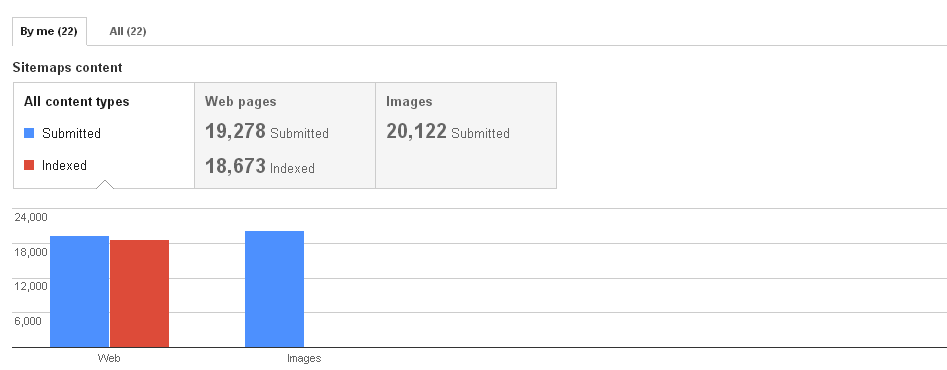 Can you please help me, why my images are not indexing in google yet? is there any issue? please give me suggestions?Thanks!
0
Can you please help me, why my images are not indexing in google yet? is there any issue? please give me suggestions?Thanks!
0 -

Google Cache Version and Text Only Version are different
Across various websites we found Google cache version in the browser loads the full site and all content is visible. However when we try to view TEXT only version of the same page we can't see any content. Example: we have a client with JS scroller menu on the home page. Each scroller serves a separate content section on the same URL. When we copy paste some of the page content in Google, we can see that copy indexed in Google search results as well as showing in Cache version . But as soon as we go into Text Only version we cant see the same copy. We would like to know which version we should trust, Google cache version or the TEXT only version.
Technical SEO | | JamesDixon700
