Moz Q&A is closed.
After more than 13 years, and tens of thousands of questions, Moz Q&A closed on 12th December 2024. Whilst we’re not completely removing the content - many posts will still be possible to view - we have locked both new posts and new replies. More details here.
How To Avoid Redirect Chains When Switching From http to https
-
I have been working on on-page SEO which has involved switching from http to https, and renaming URLs. I am running in to issues with redirect chains. Here is a scenario:
Old URL: http://bwisecontractors.ca/products/decks-and-deck-covers/
New URL: https://bwisecontractors.ca/renos-additions/sunrooms-patio-covers/
Since I already created the redirect addressing the redirecting from http to https for the root domain: (http://bwisecontractors.ca to https://bwisecontractors.ca), should the redirect for the above be
http://bwisecontractors.ca/products/decks-and-deck-covers/ to https://bwisecontractors.ca/renos-additions/sunrooms-patio-covers/ ,
or should it be
http://bwisecontractors.ca/products/decks-and-deck-covers/ to http://bwisecontractors.ca/renos-additions/sunrooms-patio-covers/ (and the root domain redirect will take care of going from http to https)
-
Thanks for the info! One of the issues I have been dealing with is speed. Good to know addressing the redirects chain will help with this as well.
-
Thanks for the feedback! Now that I know the proper way to redirect, I can determine the cause of the redirect chains.
-
As per Yoseprgr the first option. Re-direct chains negatively impact on page speed and crawlability. Hence the one chain re-direct is optimum. Google published a video - think Matt Cutts stating - they do not crawl after 4-5 redirects. SO taking into account loss of link equity, google recommendations and speed impact - the direct link is optimum.
Hope that helps.
-
You should redirect it as in your first example. A click on any url should reach its destination URL within a single redirect. A chain of redirects is creating problems with speed and crawl efficiency.
Every page should be redirected to it's corresponding https page directly.
Browse Questions
Explore more categories
-
Moz Tools
Chat with the community about the Moz tools.
-
SEO Tactics
Discuss the SEO process with fellow marketers
-
Community
Discuss industry events, jobs, and news!
-
Digital Marketing
Chat about tactics outside of SEO
-
Research & Trends
Dive into research and trends in the search industry.
-
Support
Connect on product support and feature requests.
Related Questions
-
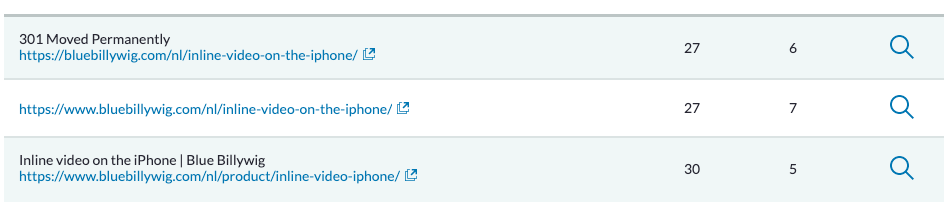
Solve Redirect Chains
I've gotten a few Redirect Issues that involve Redirect Chains, with the https:// version redirecting to the www. version and then redirecting to the right URL. Here is an example:
On-Page Optimization | | Billywig
Schermafbeelding 2021-12-07 om 11.04.32.png I've tried setting a direct redirect between the first and the last URL, but WordPress doesn't seem to allow that (it's overwritten). I've also tried checking the internal links to make sure that none of the links are the first one. They don't seem to be there. Does anyone have any tips on solving these Redirect Chains?0 -
Moz bar not working on https://www.fitness-china.com/gym-equipment-names-pictures-prices
Moz bar not working on our website about gym equipment names https://www.fitness-china.com/gym-equipment-names-pictures-prices How long fix it?
On-Page Optimization | | ahislop5740 -
SERP Hijacking/Content Theft/ 302 Redirect?
Sorry for the second post, thought this should have it's own. Here is the problem I am facing amongst many others. Let's take the search term "Air Jordan Release Dates 2017" and place it into Google Search. Here is a link:
On-Page Optimization | | SneakerFiles
https://www.google.com/#q=air+jordan+release+dates+2017 Towards the bottom of the page, you will see a website that has SneakerFiles (my website) in the title. The exact title is: Air Jordan Release Dates 2016, 2017 | SneakerFiles - Osce Now, this is my content, but not my website. For some reason, Google thinks this is my site. If you click on the link in search, it automatically redirects you to another page (maybe 302 redirect), but in the cache you can see it's mine:
http://webcache.googleusercontent.com/search?q=cache:qrVEUDE1t48J:www.osce.gob.pe/take_p_firm.asp%3F+&cd=8&hl=en&ct=clnk&gl=us I have blocked the websites IP, disallowed my style.css to be used so it just shows a links without the style, still nothing. I have submitted multiple google spam reports as well as feedback from search. At times, my page will return to the search but it gets replaced by this website. I even filed a DMCA with Google, they declined it. I reached out to their Host and Domain register multiple times, never got a response. The sad part about this, it's happening for other keywords, for example if you search "KD 9 Colorways", the first result is for my website but on another domain name (my website does rank 3rd for a different Tag page). The page I worked hard on keeping up to date. I did notice this bit of javascript from the cloaked/hacked/serp hijacking website: I disabled iFrames...(think this helps) so not sure how they are doing this. Any help would be greatly appreciated. Note: I am using Wordpress if that means anything.0 -
Why are http and https pages showing different domain/page authorities?
My website www.aquatell.com was recently moved to the Shopify platform. We chose to use the http domain, because we didn't want to change too much, too quickly by moving to https. Only our shopping cart is using https protocol. We noticed however, that https versions of our non-cart pages were being indexed, so we created canonical tags to point the https version of a page to the http version. What's got me puzzled though, is when I use open site explorer to look at domain/page authority values, I get different scores for the http vs. https version. And the https version is always better. Example: http://www.aquatell.com DA = 21 and https://www.aquatell.com DA = 27. Can somebody please help me make sense of this? Thanks,
On-Page Optimization | | Aquatell1 -
How to reduce http requests on magento
I have looked everywhere how reduce http requests on magento. couldn't find it, everyone talks about best practices but not actual answers how to implement this.
On-Page Optimization | | Mikaai1 -
Using keywords in my URL: Doing a redirect to /keyword
My website in "On Page Grade" received an A.Anyway, I only have 1 thing to optimize:_"Use Keywords in your URL__Using your targeted keywords in the URL string adds relevancy to your page for search engine rankings, assists potential visitors identify the topic of your page from the URL, and provides SEO value when used as the anchor text of referring links."_My website is ranking in top10 for a super high competitive keyword and all my others competitors have the keyword on their domain, but not for my URL.Since I can't change my domain for fixing this suggestion, I would like to know what do you think about doing a 301 redirect from / to mydomainname.com/keyword/So the index of my website would be the /keyword.I don't know if this can make a damage to my SERP for the big change ir it would be a great choice.
On-Page Optimization | | estebanseo0 -
Any idea how Google is doing this? Is it schematic? http://techcrunch.com/2014/02/28/google-adds-full-restaurant-menus-to-its-search-results-pages/
Google is now showing menus on select searches. Any idea how they are getting this information? I would like to make sure my clients get visibility this way.
On-Page Optimization | | Ron_McCabe0 -
How to avoid keyword stuffing on e-Commerce Category pages
Hi, I'm optimizing a large, consumer electronic e-commerce superstore. Based on client's choice of keywords, I'm using product category pages as my target urls. Because of the proprietary CMS structure, product names and titles, featured on my landing pages (product category pages) create a keyword overkill, affecting various ranking factors. For example, one of the target urls / landing pages, dedicated to a specific product category, mentions the keyword over 190 times because of so many product titles in the "body" section. Would inline "rel="canonical" help? If yes, what part of the website should it "canonize"? If rel="canonical" is not the answer, what strategies would you suggest? Thanks!
On-Page Optimization | | dimanyc0