Moz Q&A is closed.
After more than 13 years, and tens of thousands of questions, Moz Q&A closed on 12th December 2024. Whilst we’re not completely removing the content - many posts will still be possible to view - we have locked both new posts and new replies. More details here.
Keywords are indexed on the home page
-
Hello everyone,
For one of our websites, we have optimized for many keywords. However, it seems that every keyword is indexed on the home page, and thus not ranked properly. This occurs only on one of our many websites. I am wondering if anyone knows the cause of this issue, and how to solve it.
Thank you.
-
No, I wouldn't say that would cause such issues.
Your pages should get indexed eventually, as they are in your sitemaps (at least the ones I checked), so I am not surprised you're not seeing issues in reports.
But, tools like Moz will often struggle to give more strategic advice (not that we aren't working on it!), and in this case, if these pages are a priority, you need to prominently link to them within your site - this is the most reliably way to ensure rapid indexing.
-
@tom-capper Hey Tom, thanks a lot for all your support so far.
What I have noticed in other campaigns too, is that our websites have CLS (cumulative layout shift) problems. This is the only issue that I found in the account for Brekken. Do you know by any chance if this is something that causes pages to not get indexed correctly?
Thanks!
-
@ginovdw said in Keywords are indexed on the home page:
It seems like some of those simply aren't indexed.
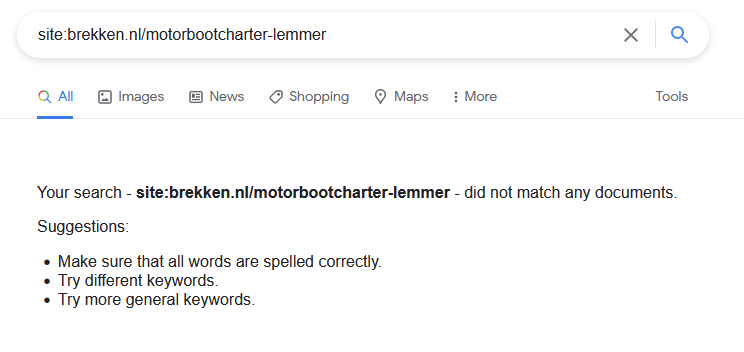
As above, I recommend you investigate in Google Search Console for a clearer idea of why it isn't indexed, but I notice with /motorbootcharter-lemmer it is listed in your sitemaps, so probably Google will index it eventually.
If you want Google to better understand the value of these pages, consider including them in your main navigation, or linking from the homepage.
-
@ginovdw Have you been able to confirm that those other pages are crawled, indexed, and correctly rendered by Google?
For example, what happens if you inspect them in Google Search Console?
-
So, an example of one of our websites is below:
We optimized the following keywords on the following pages:
Motorbootcharter Lemmer: https://brekken.nl/motorbootcharter-lemmer
Jachtverhuur Lemmer:
https://brekken.nl/jachtverhuur-lemmerBootverhuur IJsselmeer:
https://brekken.nl/bootverhuur-ijsselmeerBoot verhuur in Friesland
https://brekken.nl/boot-verhuur-in-frieslandBoot huren IJsselmeer
https://brekken.nl/boot-huren-ijsselmeerYet, they all rank on the home page of our website. Some of these words are not even mentioned on our home page, or just once. I just don't see why they don't rank on their respective keyword which we optimized for, since this works for many of our other websites.
-
@ginovdw En effet, donnez plus d'informations, sinon ce n'est pas tout à fait clair avec quoi vous comparez et avec quoi voulez-vous vous classer ?
-
@tom-capper Thanks for your response! It's exactly what you mentioned. We have many pages optimized for those terms, but they all rank on our homepage.
-
@ginovdw Heya
Could you explain a little more what you're running in to?
For example, when you say that keywords are indexed on the homepage, do you mean that your homepage is ranking for all terms, even though you have optimized other pages for those terms?
Browse Questions
Explore more categories
-
Moz Tools
Chat with the community about the Moz tools.
-
SEO Tactics
Discuss the SEO process with fellow marketers
-
Community
Discuss industry events, jobs, and news!
-
Digital Marketing
Chat about tactics outside of SEO
-
Research & Trends
Dive into research and trends in the search industry.
-
Support
Connect on product support and feature requests.
Related Questions
-
Unsolved Wild fluctuations in ranking, any thoughts on why or what to do about it?
We have a keyword which is important to us and used to have rock steady rankings for over a decade. Over the past 9 months or so it has been fluctuating all over the place. Jumping up or down 20 places or so overnight. Any thoughts on this behaviour and what we should be doing to stabilise the ranking?Screenshot 2024-05-13 at 09.47.jpg
Reporting & Analytics | | Hannahm240 -
Unsolved Mobile Rankings for me and competitors disappear in Moz but still ranking.
Hi, I'm trying to create an SEO report for my client however their mobile rankings have completely disappeared for Google Mobile rankings. Competitors rankings have disappeared as well. Could this be a Moz configuration issue?
Moz Pro | | baddjuju0 -
Dynamic Canonical Tag for Search Results Filtering Page
Hi everyone, I run a website in the travel industry where most users land on a location page (e.g. domain.com/product/location, before performing a search by selecting dates and times. This then takes them to a pre filtered dynamic search results page with options for their selected location on a separate URL (e.g. /book/results). The /book/results page can only be accessed on our website by performing a search, and URL's with search parameters from this page have never been indexed in the past. We work with some large partners who use our booking engine who have recently started linking to these pre filtered search results pages. This is not being done on a large scale and at present we only have a couple of hundred of these search results pages indexed. I could easily add a noindex or self-referencing canonical tag to the /book/results page to remove them, however it’s been suggested that adding a dynamic canonical tag to our pre filtered results pages pointing to the location page (based on the location information in the query string) could be beneficial for the SEO of our location pages. This makes sense as the partner websites that link to our /book/results page are very high authority and any way that this could be passed to our location pages (which are our most important in terms of rankings) sounds good, however I have a couple of concerns. • Is using a dynamic canonical tag in this way considered spammy / manipulative? • Whilst all the content that appears on the pre filtered /book/results page is present on the static location page where the search initiates and which the canonical tag would point to, it is presented differently and there is a lot more content on the static location page that isn’t present on the /book/results page. Is this likely to see the canonical tag being ignored / link equity not being passed as hoped, and are there greater risks to this that I should be worried about? I can’t find many examples of other sites where this has been implemented but the closest would probably be booking.com. https://www.booking.com/searchresults.it.html?label=gen173nr-1FCAEoggI46AdIM1gEaFCIAQGYARS4ARfIAQzYAQHoAQH4AQuIAgGoAgO4ArajrpcGwAIB0gIkYmUxYjNlZWMtYWQzMi00NWJmLTk5NTItNzY1MzljZTVhOTk02AIG4AIB&sid=d4030ebf4f04bb7ddcb2b04d1bade521&dest_id=-2601889&dest_type=city& Canonical points to https://www.booking.com/city/gb/london.it.html In our scenario however there is a greater difference between the content on both pages (and booking.com have a load of search results pages indexed which is not what we’re looking for) Would be great to get any feedback on this before I rule it out. Thanks!
Technical SEO | | GAnalytics1 -
Determining When to Break a Page Into Multiple Pages?
Suppose you have a page on your site that is a couple thousand words long. How would you determine when to split the page into two and are there any SEO advantages to doing this like being more focused on a specific topic. I noticed the Beginner's Guide to SEO is split into several pages, although it would concentrate the link juice if it was all on one page. Suppose you have a lot of comments. Is it better to move comments to a second page at a certain point? Sometimes the comments are not super focused on the topic of the page compared to the main text.
Technical SEO | | ProjectLabs1 -
De-indexing millions of pages - would this work?
Hi all, We run an e-commerce site with a catalogue of around 5 million products. Unfortunately, we have let Googlebot crawl and index tens of millions of search URLs, the majority of which are very thin of content or duplicates of other URLs. In short: we are in deep. Our bloated Google-index is hampering our real content to rank; Googlebot does not bother crawling our real content (product pages specifically) and hammers the life out of our servers. Since having Googlebot crawl and de-index tens of millions of old URLs would probably take years (?), my plan is this: 301 redirect all old SERP URLs to a new SERP URL. If new URL should not be indexed, add meta robots noindex tag on new URL. When it is evident that Google has indexed most "high quality" new URLs, robots.txt disallow crawling of old SERP URLs. Then directory style remove all old SERP URLs in GWT URL Removal Tool This would be an example of an old URL:
Technical SEO | | TalkInThePark
www.site.com/cgi-bin/weirdapplicationname.cgi?word=bmw&what=1.2&how=2 This would be an example of a new URL:
www.site.com/search?q=bmw&category=cars&color=blue I have to specific questions: Would Google both de-index the old URL and not index the new URL after 301 redirecting the old URL to the new URL (which is noindexed) as described in point 2 above? What risks are associated with removing tens of millions of URLs directory style in GWT URL Removal Tool? I have done this before but then I removed "only" some useless 50 000 "add to cart"-URLs.Google says themselves that you should not remove duplicate/thin content this way and that using this tool tools this way "may cause problems for your site". And yes, these tens of millions of SERP URLs is a result of a faceted navigation/search function let loose all to long.
And no, we cannot wait for Googlebot to crawl all these millions of URLs in order to discover the 301. By then we would be out of business. Best regards,
TalkInThePark0 -
Handling 301s: Multiple pages to a single page (consolidation)
Been scouring the interwebs and haven't found much information on redirecting two serparate pages to a single new page. Here is what it boils down to: Let's say a website has two pages, both with good page authority of products that are becoming fazed out. The products, Widget A and Widget B, are still popular search terms, but they are being combined into ONE product, Widget C. While Widget A and Widget B STILL have plenty to do with Widget C, Widget C is now the new page, the main focus page, and the page you want everyone to see and Google to recognize. Now, do I 301 Widget A and Widget B pages to Widget C, ALTHOUGH Widgets A and B previously had nothing to do with one another? (Remember, we want to try and keep some of that authority the two page have had.) OR do we keep Widget A and Widget B pages "alive", take them off the main navigation, and then put a "disclaimer" on the pages announcing they are now part of Widget C and link to Widget C? OR Should Widgets A and B page be canonicalized to Widget C? Again, keep in mind, widgets A and B previously were not similar, but NOW they are and result in Widget C. (If you are confused, we can provide a REAL work example of what we are talkinga about, but decided to not be specific to our industry for this.) Appreciate any and all thoughts on this.
Technical SEO | | JU19850 -
How to get Google to index another page
Hi, I will try to make my question clear, although it is a bit complex. For my site the most important keyword is "Insurance" or at least the danish variation of this. My problem is that Google are'nt indexing my frontpage on this, but are indexing a subpage - www.mydomain.dk/insurance instead of www.mydomain.dk. My link bulding will be to subpages and to my main domain, but i wont be able to get that many links to www.mydomain.dk/insurance. So im interested in making my frontpage the page that is my main page for the keyword insurance, but without just blowing the traffic im getting from the subpage at the moment. Is there any solutions to do this? Thanks in advance.
Technical SEO | | Petersen110 -
What's the difference between a category page and a content page
Hello, Little confused on this matter. From a website architectural and content stand point, what is the difference between a category page and a content page? So lets say I was going to build a website around tea. My home page would be about tea. My category pages would be: White Tea, Black Tea, Oolong Team and British Tea correct? ( I Would write content for each of these topics on their respective category pages correct?) Then suppose I wrote articles on organic white tea, white tea recipes, how to brew white team etc...( Are these content pages?) Do I think link FROM my category page ( White Tea) to my ( Content pages ie; Organic White Tea, white tea receipes etc) or do I link from my content page to my category page? I hope this makes sense. Thanks, Bill
Technical SEO | | wparlaman0