Moz Q&A is closed.
After more than 13 years, and tens of thousands of questions, Moz Q&A closed on 12th December 2024. Whilst we’re not completely removing the content - many posts will still be possible to view - we have locked both new posts and new replies. More details here.
Why does this keyword have much greater volume in Bing Keyword Research Tool than Google AdWords Keyword Planner?
-
I'm using the Google AdWords keyword planner and Bing Webmaster Keyword Research tool. For both, I'm trying to get accurate search volume for the exact term "advertising sales".
Over the last thirty days, Bing reports a volume of 5,988. Google's average monthly search volume is 880. Given the market share Google has, I would expect a much higher volume, especially when compared to Bing. Can you offer some ideas of why this might be happening?
-
Update: I checked exact match search volume on Bing using the past 30 days and on Google AdWords keyword planner using average monthly searches. For "advertising sales", Google gives me 480 and Bing gives me 11,224. Can someone offer ideas of why the issue is continuing?
-
I appreciate the reply, but I'm comparing Bing exact match to Google exact match, so that wouldn't be the cause for the discrepancy.
-
Hi Kevin,
Google's tool only give exact match search volumes whereas Bing includes broad phrase and exact match results. This might be the cause for the discrepancy in volumes. Google's data being displayed in the keyword tool might not be that current.
Cheers,
SEO5..

Browse Questions
Explore more categories
-
Moz Tools
Chat with the community about the Moz tools.
-
SEO Tactics
Discuss the SEO process with fellow marketers
-
Community
Discuss industry events, jobs, and news!
-
Digital Marketing
Chat about tactics outside of SEO
-
Research & Trends
Dive into research and trends in the search industry.
-
Support
Connect on product support and feature requests.
Related Questions
-
Inconsistent Keyword Search Volume & Difficulty Across Tools (e.g., Moz, Google Keyword Planner, Ahrefs, Semrush)
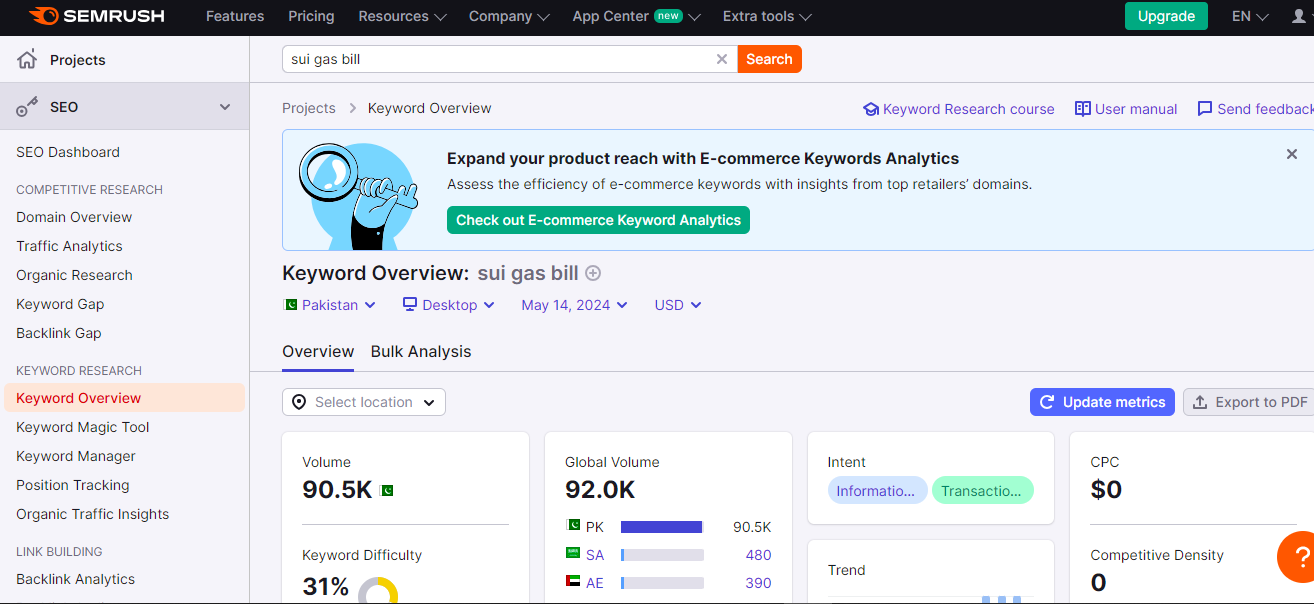
Hi there, Moz Community! I'm reaching out for some guidance on keyword research discrepancies. I'm currently targeting the keyword "sui gas bill" for my blog, sngplbill, which focuses on information related to Sui gas bills. I've used several keyword research tools, including Moz, Google Keyword Planner, Ahrefs, and Semrush, and each platform provides different search volume and keyword difficulty scores: Moz: No search volume data, Keyword Difficulty (KD) 24
Keyword Research | | Faizali.786
Google Keyword Planner: Search volume 100k-1M, Difficulty (Low)
Semrush: Search volume 90k, KD 31
Ahrefs: KD 1 (Very Easy)
These varying results are causing some confusion. Ideally, I'd like to understand which platform offers the most reliable data for search volume and keyword difficulty. Here are some additional details that might be helpful: My target location: Pakistan My Questions: What factors might contribute to these discrepancies in keyword data across different tools?
Considering my niche (Sui gas bill information in Pakistan), which platform would you recommend for the most accurate search volume and keyword difficulty estimates?
Are there any additional factors to consider beyond search volume and keyword difficulty when selecting keywords for content strategy?
Any insights you can provide would be greatly appreciated!
Capture sui gas bill semrush.PNG Capture moz sui gas bill.PNG Capture gkp sui gas bill.PNG Capture ahref sui gas bill.PNG
Thanks,0 -
German Keywords
Hi I wanted to check the volume of a keyword in German but unfortunately, it shows no data available.?
Keyword Research | | Raymonda
Is this actually possible to research German keywords with your tool?0 -
A Solution to Keywords Being Grouped in Google Keyword Planner
Hi guys, I am trying to get search traffic for a list of keywords which I put together a few years ago for one of my clients, this was before Google made changes to their Keyword Planner. When I am adding the list into Google Keyword Planner it is "grouping" a number of the keywords/phrases together, and therefore removing 13 of the keywords from the original list of 59 keywords. Is there a way around this so I can get search volume for the original list, and not the cut down one? I am specifically using Google Keyword Planner as I want to get search volume for a number of specific locations in the UK. Any comments/feedback is greatly appreciated. Thanks in advance! Jack. I19Op
Keyword Research | | ChemistryMarketing1 -
How granular should I get with Keyword research?
I'm doing KW research for a new business. My understanding from KW research guides: Use tools to create a list of thousands of keywords Analyze difficulty and search volume Reduce your list and do on page optimization for your select KWs My dilemma with this approach is that it seems "keyword based" rather than "intent" or "category" based. e.g. Let's say I have a grocery store. Ignoring SEO, I know that these are my main categories: Produce Meat Dairy Canned Goods Baked Goods In other words, the above categories are the general "intents" and "categories" that I'd really want to rank for. Keyword tool shows that they have high volume and high difficulty. Let's say that after doing keyword research, I discover "Low Fat Chicken Breasts" and "Turkey Sausage" and "Cheap Meat Wholesale" have decent search volume and low competition. I don't quite understand how I'm supposed to utilize these fringe keywords in my on page SEO plan because it doesn't make sense as a human to categorize my site that way. Not sure if this is clear. Basically I'm trying to figure out if I should really be getting this granular on keywords to help guide my store categories or if I should just be picking broader terms.
Keyword Research | | clarasboutiqueusa0 -
Has the keyword planner search volume metric gone crazy?
I use the search volume found in keyword planner to score and weight my keywords in a similar way as Rand showed us in this WBF. This week I've found that in many cases suddenly the singular and plural version of the keyword have the same search volume. This seems crazy to me as singular and plural is not the same, the intent is different but more importantly they behave very differently from each other when looking at their track record in Adwords (impressions, clicks, conversions, CTR, CVR etc...all different). For example, here's a screenshot of 4 keywords (singular and plural versions of 2 phrases) with search volume captured a couple of months ago. Now here's another screenshot of the same keywords taken from Keyword planner today. Any ideas why this would be happening? Does it makes sense to you? It just seems buggy to me. Thanks!
Keyword Research | | E_F0 -
The same keyword on multiple pages, but not all (combined with other relevant keywords) for products.
Hi Guys, I want to get an opinion/advice on this. My client has a site that have all their products (I am working on expanding the product descriptions, benefits and how they differ from each other) listed and I just want to know if I can use the term 'gear oil' for example on multiple pages as one of the keywords. The product range (among others like transmission fluid and anti-freeze) is gear oil (with the different types of gear oils available described) and I can't really change what the product is. I do have different variations (such as gear lubricant, automotive gear lubricant, car gear oil etc.) but will it do damage if I use the same keyword (like gear oil) on multiple pages (along with another relevant keyword that does not involve the words gear oil)? Any help on this will be greatly appreciated!
Keyword Research | | annabel.schoeman0 -
Where to start with keyword research for a telecom company?
Hey, I'm a brand's person with no SEO experience, yet I'm in a position where I have to carry out an SEO audit of our telecom company's website. Though our website is up and running for some years now, nobody bothered to undertake keyword research. From the little I've read over months on SEOmoz, I've just done the following: took out keywords bringing organic traffic on to our website and checked our rankings for those keywords on major search engines. My observation is that most of these words are long-tail keywords. Since we only have product/service information related to our offerings, most of the head terms we've used for packages/offers/services pages are branded keywords. My understanding is that we need to rank top for our branded keywords (a must) and try to rank as high as possible for long tail. In addition, we can use those keywords in our copy so that the right page ranks top for the respective keyword. Am I missing anything here? What else do I need to do?
Keyword Research | | HasanPK0 -
Is "in" a keyword differentiator?
Does google view phrases with "in" in then as different keywords than the same phrase without an "in"? For example: is "great restaurants in chicago" the same keyword as "great restaurants chicago"? Whenever I do research on two phrases like this, they always come up with the same search volume.
Keyword Research | | TheSquareFoot0