Moz Q&A is closed.
After more than 13 years, and tens of thousands of questions, Moz Q&A closed on 12th December 2024. Whilst we’re not completely removing the content - many posts will still be possible to view - we have locked both new posts and new replies. More details here.
Is there an ideal ratio of keyword difficulty to search volume?
-
I used the keyword research tool to pull data on potential keywords, the report returns a percentage to represent the competition and difficulty of a keyword. Is there an ideal ratio of percent difficulty to search volume
-
Google Webmaster tools will tell your the click through rate from the SERPS and Google Analytics can be used to measure the conversion rate. You'll need to define your site goal and think about how visitors move through your site from their landing page to your site goal pages.
-
Thank you. Do you know of any good tools to measure the conversion rate or click thru rate of keyword?
-
No, there's no ideal ratio as such and it's always a good idea to look beyond the headline numbers, especially the relevance of the pages being returned in the SERPS.
You're looking for good volumes of search traffic with as little competition as possible. While those large traffic numbers for highly competitive keywords may look attractive, you may be better off targeting less competitive keywords with smaller amounts of traffic.
Think of it this way a large slice of a small pie is going to be better than just crumbs from a large pie.
However there are other factors to consider beside just traffic and difficulty. You also need to think about user intent, relevance to content / brand / offering and once you start getting some traffic the conversion rate.
-
Competition difficulty level only shows sites on first pages SERPs. For example: If wiki is up there it throws the number off or just makes it look way more challenging.
Is there an ideal ratio of percent difficulty to search volume?
No there is not. There are plenty of keywords out there with huge traffic volume and no competition. For the most part profitable keywords are more challenging.
Browse Questions
Explore more categories
-
Moz Tools
Chat with the community about the Moz tools.
-
SEO Tactics
Discuss the SEO process with fellow marketers
-
Community
Discuss industry events, jobs, and news!
-
Digital Marketing
Chat about tactics outside of SEO
-
Research & Trends
Dive into research and trends in the search industry.
-
Support
Connect on product support and feature requests.
Related Questions
-
Inconsistent Keyword Search Volume & Difficulty Across Tools (e.g., Moz, Google Keyword Planner, Ahrefs, Semrush)
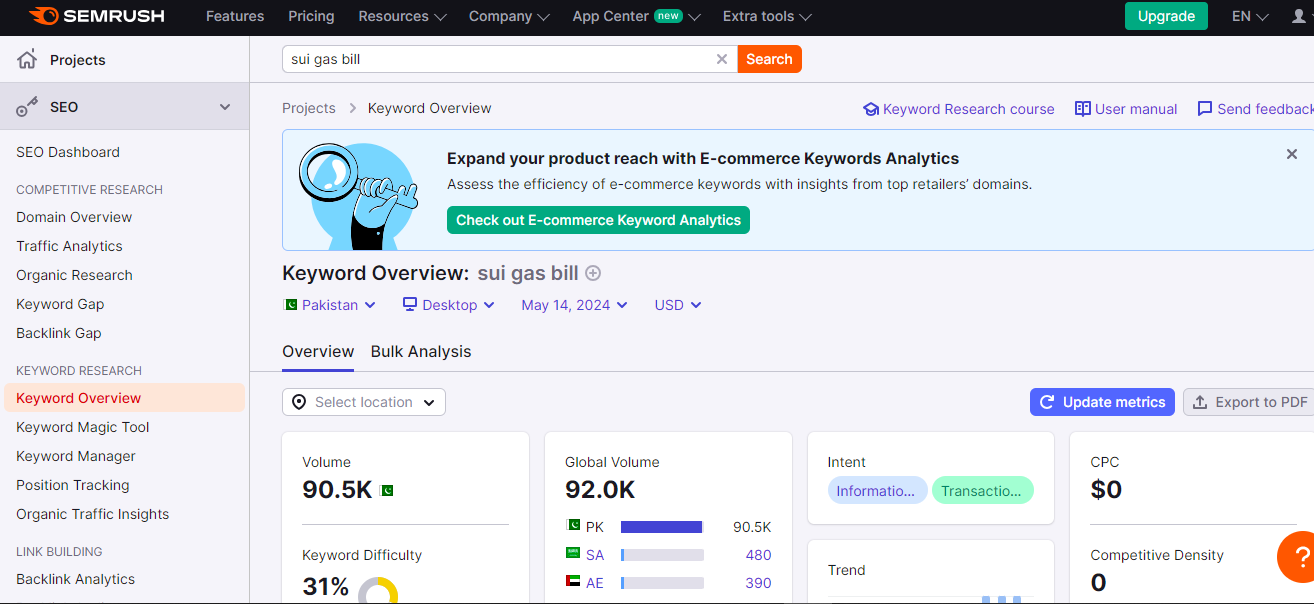
Hi there, Moz Community! I'm reaching out for some guidance on keyword research discrepancies. I'm currently targeting the keyword "sui gas bill" for my blog, sngplbill, which focuses on information related to Sui gas bills. I've used several keyword research tools, including Moz, Google Keyword Planner, Ahrefs, and Semrush, and each platform provides different search volume and keyword difficulty scores: Moz: No search volume data, Keyword Difficulty (KD) 24
Keyword Research | | Faizali.786
Google Keyword Planner: Search volume 100k-1M, Difficulty (Low)
Semrush: Search volume 90k, KD 31
Ahrefs: KD 1 (Very Easy)
These varying results are causing some confusion. Ideally, I'd like to understand which platform offers the most reliable data for search volume and keyword difficulty. Here are some additional details that might be helpful: My target location: Pakistan My Questions: What factors might contribute to these discrepancies in keyword data across different tools?
Considering my niche (Sui gas bill information in Pakistan), which platform would you recommend for the most accurate search volume and keyword difficulty estimates?
Are there any additional factors to consider beyond search volume and keyword difficulty when selecting keywords for content strategy?
Any insights you can provide would be greatly appreciated!
Capture sui gas bill semrush.PNG Capture moz sui gas bill.PNG Capture gkp sui gas bill.PNG Capture ahref sui gas bill.PNG
Thanks,0 -
How do I do keyword research when search volume is unknown
Hi Mozzers! I do a lot of work in niche areas, and one issue I often confront in keyword research is unknown search volume. That is, I'll be doing keyword research in Keyword Explorer or Gooogle Search Console, and for the most relevant keywords, I find either very low search volumes, null search volumes, or "Data not available." How do I make good keyword planning decisions when I can't find good data for search volume? Thanks for sharing your thoughts. Andy
Keyword Research | | AndyKubrin0 -
Multilingual keyword research
Does anyone have any experience in multilingual SEO? We are looking for software that conducts research for GEO Locations such as UAE, Oman, Bahrain, Kuwait, Qatar, Saudi Arabia, Pakistan & India. Writing content for each of these countries is difficult unless we speak their language, we could look at outsourcing the translation but conducting keyword research for each location is almost impossible.
Keyword Research | | Jseddon920 -
Why does this keyword have much greater volume in Bing Keyword Research Tool than Google AdWords Keyword Planner?
I'm using the Google AdWords keyword planner and Bing Webmaster Keyword Research tool. For both, I'm trying to get accurate search volume for the exact term "advertising sales". Over the last thirty days, Bing reports a volume of 5,988. Google's average monthly search volume is 880. Given the market share Google has, I would expect a much higher volume, especially when compared to Bing. Can you offer some ideas of why this might be happening?
Keyword Research | | Kevin_P0 -
Is there any way to track search volume for a particular keyword on a day-to-day basis?
My boss has asked me to track the number of searches for a keyword (a particular company's name) on a daily basis this week to see how the volume fluctuates from day to day. Is this even possible? I should note that his request does not involve an active SEO or AdWords campaign. In fact, the company my boss is interested in doesn't even have a website at the moment. Thanks in advance – either for helping me confirm that it's impossible to track keyword search volume on a day-to-day basis, or for showing me the magical way to actually do this.
Keyword Research | | matt-145670 -
Keywords + Country?
Hey guys, Let's say that I'm doing on-site SEO for a website that sells football shirts. This website targets 5 different countries. We only have a .com domain and no other country specific domains will be added at this point. When I choose the keywords, do I opt for product name + country or only product name? football shirts france or football shirts? Some info: Countries have been added in the title of the pages. Countries appear in the footer. Thank You.
Keyword Research | | BruLee0 -
Keyword Research (dash or no dash)
I have a client that has been optimizing for "print and apply" for the past 5 months. Yesterday they decided it was more grammatically correct to use "print-and-apply." There question to me was "is this going to effect our SEO?" So... I checked the difficulty using the keyword analysis tool, both keywords had the same broad/exact adwords traffic as well as difficulty percentage. When reviewing the top 25 listings for each keyword it looks like the same sites rank in the SERPs between 1-8 and then after that it is completely different. So, is there a better keyword to target? Are these two keywords different enough to truly have separate search results?
Keyword Research | | kchandler
The top 8 results didn't even target "print-and-apply" in there content or title tags... Thanks for the input/discussion - Kyle0 -
How do search engines score "nested" keywords?
I use "nested" for lack of a better term; what I mean is keyword phrases that contain other keyword phrases. For example, if I have a page that is extremely well optimized (on-page) for the phrase "old silver coins", is that page by default also extremely well optimized (on-page) for the phrase "silver coins"? Or does google understand that I am optimizing for the longer phrase "old silver coins" and somehow exclude me from contention for the sub-phrase "silver coins"? I understand that this gets more complicated when talking about backlinks (off-page), but the same general question remains. If I am getting good backlinks for "old silver coins", am I also getting good backlinks for "silver coins" at the same time? I do understand that "silver coins" may be more competitive than "old silver coins" and so my page may not rank the same for the two phrases. But I am really curious if there is some kind of multiplier effect with nested keyword phrases like the example I have provided, or whether google somehow only credits for the full phrase and not for any sub-phrases contained therein. Any insight would be greatly appreciated! (And sorry if this has been addressed already. I have looked around the site and have googled this question, but haven't found anything useful yet.) Thanks. BONUS QUESTION: Are the answers to my questions above exactly the same when discussing singular versus plural keywords ("coins" versus "coin")? After all, that is a "nested case just like my examples above. On the other hand, I can see there being some special treatment of singular and plural.
Keyword Research | | Kp2221