Moz Q&A is closed.
After more than 13 years, and tens of thousands of questions, Moz Q&A closed on 12th December 2024. Whilst we’re not completely removing the content - many posts will still be possible to view - we have locked both new posts and new replies. More details here.
MBG Tracker...how to use it?
-
So I am a new blogger that has been submitting guest blog posts to a number of different blogs. It was recommended that I use the MBG Tracker so I can track the back links. The problem is that I am totally lost on how to use this tool. As I said before I am new to this whole thing and I am not really sure what constitutes a "base link" and a "back link." In the author bylines we are linking to different pages within a larger website. If anyone can help me I would really appreciate it!
-
Thanks for the reply Ann! David, SEOmoz and MyBlogGuest are different products, you'll probably find the best help for MBG talking with Ann or using her support forums.
-
Let me try to be very clear. Please email if you have more questions (I got both of your emails, so feel free to use the email)
When guest blogging, are you promoting ONE site in your byline in each of the guest posts? There can be different pages from one site, but one and the same domain.
For example:
- Project name: SEOmoz
- Base domain: seomoz.org
Then when you decide to upload this page, for example: http://www.geekwire.com/2012/seomoz-secret-startup-success-rand-fishkins-tips/ - the tracker will automatically identify the backlink to track - http://www.seomoz.org/dp/seattle-startup-marketing - because it has seomoz.org base domain.
By providing the base domain, you make your own job easier because you don't have to manually provide the tool with the backlink to track!
-
So the base link would be the link to the blog post and the back link is the link that goes back to my site? Is this correct? I had seen the site that you suggested but like I said I was confused by the base link and the back link.
-
Base link is a normal submission with a link. Back link has more value with guest blogging.
HOW DOES THE BACKLINK MONITORING TOOL WORK?
This is the cheapest and simplest alternative I am aware of:
- Receive instant emails if any of your links were removed or nofollowed;
- Track your guest post social popularity (Likes and Tweets)
- Measure traffic from each of your guest posts (for that you’ll need to install a tracking code)
- Identify most efficient backlink sources (for example, to find places where you canguest post again).
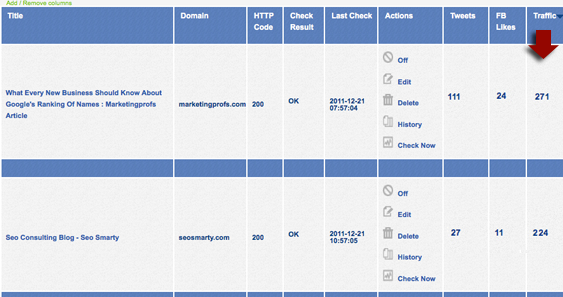
To start tracking your guest posts or links, you’ll need to create a new project and specify your base URL. For all pages you add within one project, this very base URL will be monitored automatically (even if you don’t specify which link within a given page you want to track).
You can add / remove columns from the table (to adjust a clearer view) and sort by each column. You will also receive weekly summaries of your missing links and most popular link sources.
Handy url for more info..... http://www.seosmarty.com/meet-mbg-tracker-the-simplest-and-cheapest-way-to-monitor-your-backlinks/
Got a burning SEO question?
Subscribe to Moz Pro to gain full access to Q&A, answer questions, and ask your own.
Browse Questions
Explore more categories
-
Moz Tools
Chat with the community about the Moz tools.
-
SEO Tactics
Discuss the SEO process with fellow marketers
-
Community
Discuss industry events, jobs, and news!
-
Digital Marketing
Chat about tactics outside of SEO
-
Research & Trends
Dive into research and trends in the search industry.
-
Support
Connect on product support and feature requests.
Related Questions
-
Correct use of schema for online store and physical stores
I have been getting conflicting advice on the best way to implement schema for the following scenario. There is a central e-commerce store that is registered to it's own unique address which is "head office". There are a few physical shops each of which has their own location and address. Each shop has its own landing page within /our-stores/. So each page on the website has the Organisation schema for the central 'organisation', something like: Then on each physical store landing page is something like the following as well as the Organisation schema: Is this correct? If it is should I extend LocalBusiness with store URL and sameAs for GMB listing and maybe Companies House registration? It's also been suggested that we should use LocalBusiness for the head office of the company, then Departmentwith the typeStore. But i'm not sure on that?
Technical SEO | | MickEdwards0 -
Is it better to use XXX.com or XXX.com/index.html as canonical page
Is it better to use 301 redirects or canonical page? I suspect canonical is easier. The question is, which is the best canonical page, YYY.com or YYY.com/indexhtml? I assume YYY.com, since there will be many other pages such as YYY.com/info.html, YYY.com/services.html, etc.
Technical SEO | | Nanook10 -
Does the use of sliders for text-on-page, effects SEO in any way?
The concept of using text sliders in an e-commerce site as a solution to placing SEO text above or in between product and high on ages, seems too good to be true.... or is it? How would a text slider for FAQ or other on-page text done with sliding paragraphs (similar but not this specific code- http://demo.tutorialzine.com/2010/08/dynamic-faq-jquery-yql-google-docs/faq.html) might effect text-on-page SEO. Does Google consider it hidden text? Would there be any other concerns or best practices with this design concept? faq.html
Technical SEO | | RKanfi0 -
What should be use 301 or 302 redirection for 404 pages
Please suggest which redirection we should use for 404 pages- 301 or 302. If you can elaborate it with reason then it will be highly appreciated.
Technical SEO | | koamit0 -
Can you mark up a page using Schema.org and Facebook Open Graph?
Is it possible to use both Schema.org and Facebook Open Graph for structured data markup? On the Google Webmaster Central blog, they say, "you should avoid mixing the formats together on the same web page, as this can confuse our parsers." Source - http://googlewebmastercentral.blogspot.com/2011/06/introducing-schemaorg-search-engines.html
Technical SEO | | SAMarketing1 -
OK to block /js/ folder using robots.txt?
I know Matt Cutts suggestions we allow bots to crawl css and javascript folders (http://www.youtube.com/watch?v=PNEipHjsEPU) But what if you have lots and lots of JS and you dont want to waste precious crawl resources? Also, as we update and improve the javascript on our site, we iterate the version number ?v=1.1... 1.2... 1.3... etc. And the legacy versions show up in Google Webmaster Tools as 404s. For example: http://www.discoverafrica.com/js/global_functions.js?v=1.1
Technical SEO | | AndreVanKets
http://www.discoverafrica.com/js/jquery.cookie.js?v=1.1
http://www.discoverafrica.com/js/global.js?v=1.2
http://www.discoverafrica.com/js/jquery.validate.min.js?v=1.1
http://www.discoverafrica.com/js/json2.js?v=1.1 Wouldn't it just be easier to prevent Googlebot from crawling the js folder altogether? Isn't that what robots.txt was made for? Just to be clear - we are NOT doing any sneaky redirects or other dodgy javascript hacks. We're just trying to power our content and UX elegantly with javascript. What do you guys say: Obey Matt? Or run the javascript gauntlet?0 -
Using Schema.org: Product or Event as the schema type?
Hello, Most of you heard from the launch of the new format for microdata: Schema.org and my question is about the different types of Schema they provide. Our websites provide an overview of courses, visitors can search/filter training courses and most important: read peer reviews. Until now we formatted (the source) of those courses with the schema type "Product" because it allows us to provide search engines with metadata about reviews via the "Aggregrated Rating". Recently we updated the information about courses, to also provide start dates and locations to users, just like the schema type for: "Events". Because we would like to provide search engines also with both types of data I would like to know your opinion. Schema.org looks like not to support the Aggregated Rating for Events and vice versa for Startdates/Locations for the Product type. And combining the two Schema types also does not looks like an option because we can't put them on the same level like it should be. So what would you recommend to use for kind of schema type(s), are we able to use the 'Product' type next to the 'Event' type and so to combine them? Thanks a lot!
Technical SEO | | Martijn_Scheijbeler0