Moz Q&A is closed.
After more than 13 years, and tens of thousands of questions, Moz Q&A closed on 12th December 2024. Whilst we’re not completely removing the content - many posts will still be possible to view - we have locked both new posts and new replies. More details here.
MBG Tracker...how to use it?
-
So I am a new blogger that has been submitting guest blog posts to a number of different blogs. It was recommended that I use the MBG Tracker so I can track the back links. The problem is that I am totally lost on how to use this tool. As I said before I am new to this whole thing and I am not really sure what constitutes a "base link" and a "back link." In the author bylines we are linking to different pages within a larger website. If anyone can help me I would really appreciate it!
-
Thanks for the reply Ann! David, SEOmoz and MyBlogGuest are different products, you'll probably find the best help for MBG talking with Ann or using her support forums.
-
Let me try to be very clear. Please email if you have more questions (I got both of your emails, so feel free to use the email)
When guest blogging, are you promoting ONE site in your byline in each of the guest posts? There can be different pages from one site, but one and the same domain.
For example:
- Project name: SEOmoz
- Base domain: seomoz.org
Then when you decide to upload this page, for example: http://www.geekwire.com/2012/seomoz-secret-startup-success-rand-fishkins-tips/ - the tracker will automatically identify the backlink to track - http://www.seomoz.org/dp/seattle-startup-marketing - because it has seomoz.org base domain.
By providing the base domain, you make your own job easier because you don't have to manually provide the tool with the backlink to track!
-
So the base link would be the link to the blog post and the back link is the link that goes back to my site? Is this correct? I had seen the site that you suggested but like I said I was confused by the base link and the back link.
-
Base link is a normal submission with a link. Back link has more value with guest blogging.
HOW DOES THE BACKLINK MONITORING TOOL WORK?
This is the cheapest and simplest alternative I am aware of:
- Receive instant emails if any of your links were removed or nofollowed;
- Track your guest post social popularity (Likes and Tweets)
- Measure traffic from each of your guest posts (for that you’ll need to install a tracking code)
- Identify most efficient backlink sources (for example, to find places where you canguest post again).
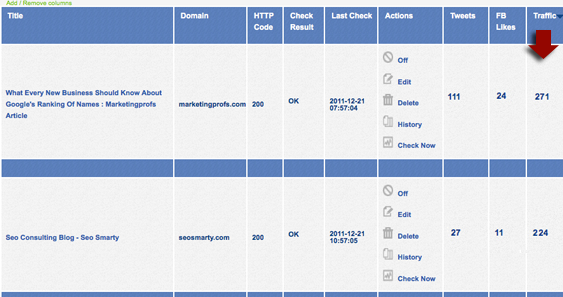
To start tracking your guest posts or links, you’ll need to create a new project and specify your base URL. For all pages you add within one project, this very base URL will be monitored automatically (even if you don’t specify which link within a given page you want to track).
You can add / remove columns from the table (to adjust a clearer view) and sort by each column. You will also receive weekly summaries of your missing links and most popular link sources.
Handy url for more info..... http://www.seosmarty.com/meet-mbg-tracker-the-simplest-and-cheapest-way-to-monitor-your-backlinks/
Got a burning SEO question?
Subscribe to Moz Pro to gain full access to Q&A, answer questions, and ask your own.
Browse Questions
Explore more categories
-
Moz Tools
Chat with the community about the Moz tools.
-
SEO Tactics
Discuss the SEO process with fellow marketers
-
Community
Discuss industry events, jobs, and news!
-
Digital Marketing
Chat about tactics outside of SEO
-
Research & Trends
Dive into research and trends in the search industry.
-
Support
Connect on product support and feature requests.
Related Questions
-
Unsolved Using NoIndex Tag instead of 410 Gone Code on Discontinued products?
Hello everyone, I am very new to SEO and I wanted to get some input & second opinions on a workaround I am planning to implement on our Shopify store. Any suggestions, thoughts, or insight you have are welcome & appreciated! For those who aren't aware, Shopify as a platform doesn't allow us to send a 410 Gone Code/Error under any circumstance. When you delete or archive a product/page, it becomes unavailable on the storefront. Unfortunately, the only thing Shopify natively allows me to do is set up a 301 redirect. So when we are forced to discontinue a product, customers currently get a 404 error when trying to go to that old URL. My planned workaround is to automatically detect when a product has been discontinued and add the NoIndex meta tag to the product page. The product page will stay up but be unavailable for purchase. I am also adjusting the LD+JSON to list the products availability as Discontinued instead of InStock/OutOfStock.
Technical SEO | | BakeryTech
Then I let the page sit for a few months so that crawlers have a chance to recrawl and remove the page from their indexes. I think that is how that works?
Once 3 or 6 months have passed, I plan on archiving the product followed by setting up a 301 redirect pointing to our internal search results page. The redirect will send the to search with a query aimed towards similar products. That should prevent people with open tabs, bookmarks and direct links to that page from receiving a 404 error. I do have Google Search Console setup and integrated with our site, but manually telling google to remove a page obviously only impacts their index. Will this work the way I think it will?
Will search engines remove the page from their indexes if I add the NoIndex meta tag after they have already been index?
Is there a better way I should implement this? P.S. For those wondering why I am not disallowing the page URL to the Robots.txt, Shopify won't allow me to call collection or product data from within the template that assembles the Robots.txt. So I can't automatically add product URLs to the list.0 -
Should we use Cloudflare
Hi all, we want to speed up our website (hosted in Wordpress, traffic around 450,000 page views monthly), we use lots of images. And we're wondering about setting up on Cloudflare, however after searching a bit in Google I have seen some people say the change in IP, or possible sharing of Its with bad neighbourhoods, can really hit search rankings. So, I was wondering what the latest thinking is on this subject, would the increased speed and local server locations be a boost for SEO, moreso than a potential loss of rankings for changing IP? Thanks!
Technical SEO | | tiromedia1 -
Optimal use of keywords in header tag
what does optimal use of keywords in header tag actually mean given you indicate this as hurting seo factor?
Technical SEO | | Serg1550 -
Using 410 To Remove URLs Starting With Same Word
We had a spam injection a few months ago. We successfully cleaned up the site and resubmitted to google. I recently received a notification showing a spike in 404 errors. All of the URLS have a common word at the beginning injected via the spam: sitename.com/mono
Technical SEO | | vikasnwu
sitename.com/mono.php?buy-good-essays
sitename.com/mono.php?professional-paper-writer There's about 100 total URLS with the same syntax with the word "mono" in them. Based on my research, it seems that it would be best to serve a 410. I wanted to know what the line of HTACCESS code would be to do that in bulk for any URL that has the word "mono" after the sitename.com/0 -
Guys & Gals anyone know if urllist.txt is still used?
I'm using a tool which generates urllist.txt and looking on the SEO Forums it seems that Yahoo used to use this. What I'd like to know is is it still used anywhere and should we have it on the site?
Technical SEO | | danwebman0 -
NoIndex/NoFollow pages showing up when doing a Google search using "Site:" parameter
We recently launched a beta version of our new website in a subdomain of our existing site. The existing site is www.fonts.com with the beta living at new.fonts.com. We do not want Google to crawl the new site until it's out of beta so we have added the following on all pages: However, one of our team members noticed that google is displaying results from new.fonts.com when doing an "site:new.fonts.com" search (see attached screenshot). Is it possible that Google is indexing the content despite the noindex, nofollow tags? We have double checked the syntax and it seems correct except the trailing "/". I know Google still crawls noindexed pages, however, the fact that they're showing up in search results using the site search syntax is unsettling. Any thoughts would be appreciated! DyWRP.png
Technical SEO | | ChrisRoberts-MTI0 -
Trailing Slashes In Url use Canonical Url or 301 Redirect?
I was thinking of using 301 redirects for trailing slahes to no trailing slashes for my urls. EG: www.url.com/page1/ 301 redirect to www.url.com/page1 Already got a redirect for non-www to www already. Just wondering in my case would it be best to continue using htacces for the trailing slash redirect or just go with Canonical URLs?
Technical SEO | | upick-1623910 -
Using Schema.org: Product or Event as the schema type?
Hello, Most of you heard from the launch of the new format for microdata: Schema.org and my question is about the different types of Schema they provide. Our websites provide an overview of courses, visitors can search/filter training courses and most important: read peer reviews. Until now we formatted (the source) of those courses with the schema type "Product" because it allows us to provide search engines with metadata about reviews via the "Aggregrated Rating". Recently we updated the information about courses, to also provide start dates and locations to users, just like the schema type for: "Events". Because we would like to provide search engines also with both types of data I would like to know your opinion. Schema.org looks like not to support the Aggregated Rating for Events and vice versa for Startdates/Locations for the Product type. And combining the two Schema types also does not looks like an option because we can't put them on the same level like it should be. So what would you recommend to use for kind of schema type(s), are we able to use the 'Product' type next to the 'Event' type and so to combine them? Thanks a lot!
Technical SEO | | Martijn_Scheijbeler0