Moz Q&A is closed.
After more than 13 years, and tens of thousands of questions, Moz Q&A closed on 12th December 2024. Whilst we’re not completely removing the content - many posts will still be possible to view - we have locked both new posts and new replies. More details here.
Sudden Drop in Mobile Core Web Vitals
-

For some reason, after all URLs being previously classified as Good, our Mobile Web Vitals report suddenly shifted to the above, and it doesn't correspond with any site changes on our end.
Has anyone else experience something similar or have any idea what might have caused such a shift?
Curiously I'm not seeing a drop in session duration, conversion rate etc. for mobile traffic despite the seemingly sudden change.
-
I can’t understand their algorithm for core web vitals. I have made some technical updates to our website for speed optimization, but the thing that happened in the search console is very confusing for my site.
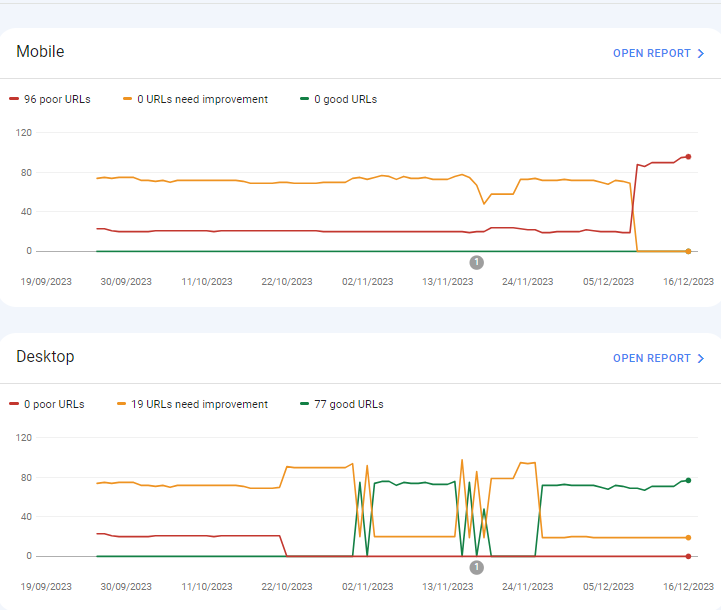
For desktops, pages are indexed as good URLs
while mobile-indexed URLs are displayed as poor URLs.
Our website is the collective material for people looking for Canada immigration (PAIC), and 70% of the portion is filled with text only. We are using webp images for optimization, still it is not passing Core Web Vitals.I am looking forward to the expert’s suggestion to overcome this problem.
-
I can’t understand their algorithm for core web vitals. I have made some technical updates to our website for speed optimization, but the thing that happened in the search console is very confusing for my site.
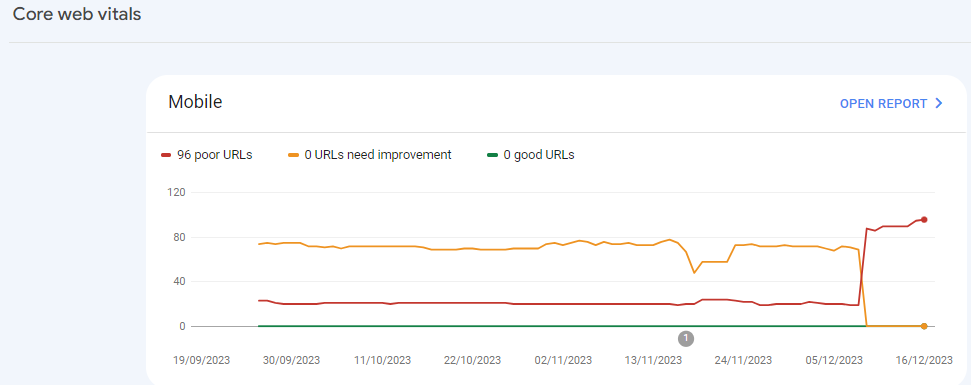
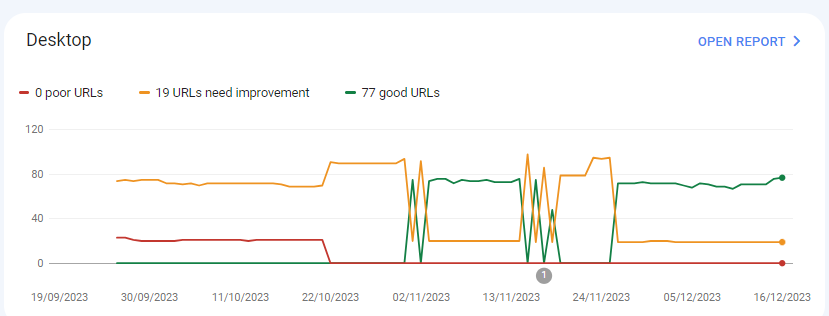
For desktops, pages are indexed as good URLs
while mobile-indexed URLs are displayed as poor URLs.
Our website is the collective material for people looking for Canadian immigration (PAIC), and 70% of the portion is filled with text only. We are using webp images for optimization, still it is not passing Core Web Vitals.I am looking forward to the expert’s suggestion to overcome this problem.
-
@rwat Hi, did you find a solution?
-
Yes, I am also experiencing the same for one of my websites, but most of them are blog posts and I am using a lot of images without proper optimization, so that could be the reason. but not sure.
It is also quite possible that Google maybe adding some more parameters to their main web critical score.
Got a burning SEO question?
Subscribe to Moz Pro to gain full access to Q&A, answer questions, and ask your own.
Browse Questions
Explore more categories
-
Moz Tools
Chat with the community about the Moz tools.
-
SEO Tactics
Discuss the SEO process with fellow marketers
-
Community
Discuss industry events, jobs, and news!
-
Digital Marketing
Chat about tactics outside of SEO
-
Research & Trends
Dive into research and trends in the search industry.
-
Support
Connect on product support and feature requests.
Related Questions
-
Best redirect destination for 18k highly-linked pages
Technical SEO question regarding redirects; I appreciate any insights on best way to handle. Situation: We're decommissioning several major content sections on a website, comprising ~18k webpages. This is a well established site (10+ years) and many of the pages within these sections have high-quality inbound links from .orgs and .edus. Challenge: We're trying to determine the best place to redirect these 18k pages. For user experience, we believe best option is the homepage, which has a statement about the changes to the site and links to the most important remaining sections of the site. It's also the most important page on site, so the bolster of 301 redirected links doesn't seem bad. However, someone on our team is concerned that that many new redirected pages and links going to our homepage will trigger a negative SEO flag for the homepage, and recommends instead that they all go to our custom 404 page (which also includes links to important remaining sections). What's the right approach here to preserve remaining SEO value of these soon-to-be-redirected pages without triggering Google penalties?
Technical SEO | | davidvogel1 -
Unsolved Capturing Source Dynamically for UTM Parameters
Does anyone have a tutorial on how to dynamically capture the referring source to be populated in UTM parameters for Google Analytics? We want to syndicate content and be able to see all of the websites that provided referral traffic for this specific objective. We want to set a specific utm_medium and utm_campaign but have the utm_source be dynamic and capture the referring website. If we set a permanent utm_source, it would appear the same for all incoming traffic. Thanks in advance!
Technical SEO | | peteboyd0 -
Need some help understanding SEO - Please help before I lose [pull out] all my hair
I'm new to SEO, and am stubbornly trying to educate myself. I have a telescope shop in Canada, it's a small business that we run on the side. We're driving lots of traffic through FB and our outreach programs but I really want to increase our presence on search. We released a new website back in January and it killed some of our rankings. We're working our way back with a very specific set of efforts on regular SEO: Metadata and titles, although it seems that's not super relevant Building high quality backlinks and eliminating any spammy backlinks Rewriting product listings so that they are original content though I'm not sure how important this is in e-commerce Writing high quality articles and blog posts Working relevant keywords into our product pages and titles I understand that good SEO is about pushing on all the levers, and trying to make sure that your site is as valuable to the end user as possible. We're making some good progress, but I'm puzzled by the #1 shop in Canada. They don't put any apparent effort into SEO and they still rank #1 on every key product we compete with them on. I've worked with two separate, highly ranked and regarded SEO firms on this and neither has been able to tell my why this other site ranks so highly. Here's a specific example on a popular product that we both sell, the Celestron NexStar 8SE. Here’s the link to Telescope Canada’s page for their Celestron 8SE: https://telescopescanada.ca/products/celestron-nexstar-8se-computerized-telescope-11069 Here’s a link to the Celestron 8SE page from the manufacturer website: https://www.celestron.com/products/nexstar-8se-computerized-telescope Telescopes Canada has just copied and pasted. There is no original content aside from adding the shipping and return policy to the tab, and having some options for selecting accessories on the page. Here is our page: https://all-startelescope.com/products/celestron-nexstar-8se We have higher page authority, higher domain authority, and they keyword analyzer in moz says that our page is higher quality than the Telescopes Canada page. I can’t find a single metric on any tool (ubbersuggest, Moz, ahrefs, semrush) that says Telescopes Canada is a better site, or has a better NexStar 8SE product page. But they keep ranking ahead of us, and right at the top of google search. Our titles are good, our metadata is good (but I don’t think that’s been a serious ranking factor for about ten years). Our text is original, it’s relevant, we have healthy internal links to the page. According to Moz's page ranker it's 20 points higher than Telescope Canada's page. We have invensted in some excellent blog content, we’re adding new products to the website so that we rank for more keywords. All of those things are helping, but I fundamentally don’t understand why Telescopes Canada is #1 almost across the board on every key product in our market. There is something that I’m not seeing here. Can you see any metric, any tool in your toolbox that indicates why they rank at the top, or even higher than we do for in these search terms specific to that product: Celestron NexStar 8SE
Intermediate & Advanced SEO | | nkennett
NexStar 8SE
Celestron NexStar 8SE Canada
NexStar 8SE Canada I have a feeling it's something technical that I'm missing, but I'm not sure how obvious it is with two 'professional' firms not finding it. I'd really appreciate any help or insight that you can offer.0 -
Unsolved Duplicate LocalBusiness Schema Markup
Hello! I've been having a hard time finding an answer to this specific question so I figured I'd drop it here. I always add custom LocalBusiness markup to clients' homepages, but sometimes the client's website provider will include their own automated LocalBusiness markup. The codes I create often include more information. Assuming the website provider is unwilling to remove their markup, is it a bad idea to include my code as well? It seems like it could potentially be read as spammy by Google. Do the pros of having more detailed markup outweigh that potential negative impact?
Local Website Optimization | | GoogleAlgoServant0 -
Do web design footer links of websites you build have value?
Hi everyone. I am trying to build up DA for my site and create linking opportunities with my clients sites but I am not seeing any link value. I just did a redesign with another firm and we built out www.denbow.com . We have links to our sites in the footer but for some reason it's not being indexed. Can someone help me understand if it is good to put built by a href link in the footer? I've built almost 12 sites in my first 1.5 years of being in business for myself and I thought the links would pass some sort of value. Thanks in advance for the help and education. Regards, Noob Gary
Technical SEO | | gdavey0 -
Why has my search traffic suddenly tanked?
On 6 June, Google search traffic to my Wordpress travel blog http://www.travelnasia.com tanked completely. There are no warnings or indicators in Webmaster Tools that suggest why this happened. Traffic from search has remained at zero since 6 June and shows no sign of recovering. Two things happened on or around 6 June. (1) I dropped my premium theme which was proving to be not mobile friendly and replaced it with the ColorMag theme which is responsive. (2) I relocated off my previous hosting service which was showing long server lag times to a faster host. Both of these should have improved my search performance, not tanked it. There were some problems with the relocation to the new web host which resulted in a lot of "out of memory" errors on the website for 3-4 days. The allowed memory was simply not enough for the complexity of the site and the volume of traffic. After a few days of trying to resolve these problems, I moved the site to another web host which allows more PHP memory and the site now appears reliably accessible for both desktop and mobile. But my search traffic has not recovered. I am wondering if in all of this I've done something that Google considers to be a cardinal sin and I can't see it. The clues I'm seeing include: Moz Pro was unable to crawl my site last Friday. It seems like every URL it tried to crawl was of the form http://www.travelnasia.com/wp-login.php?action=jetpack-sso&redirect_to=http://www.travelnasia.com/blog/bangkok-skytrain-bts-mrt-lines which resulted in a 500 status error. I don't know why this happened but I have disabled the Jetpack login function completely, just in case it's the problem. GWT tells me that some of my resource files are not accessible by GoogleBot due to my robots.txt file denying access to /wp-content/plugins/. I have removed this restriction after reading the latest advice from Yoast but I still can't get GWT to fetch and render my posts without some resource errors. On 6 June I see in Structured Data of GWT that "items" went from 319 to 1478 and "items with errors" went from 5 to 214. There seems to be a problem with both hatom and hcard microformats but when I look at the source code they seem to be OK. What I can see in GWT is that each hcard has a node called "n [n]" which is empty and Google is generating a warning about this. I see that this is because the author vcard URL class now says "url fn n" but I don't see why it says this or how to fix it. I also don't see that this would cause my search traffic to tank completely. I wonder if anyone can see something I'm missing on the site. Why would Google completely deny search traffic to my site all of a sudden without notifying any kind of penalty? Note that I have NOT changed the content of the site in any significant way. And even if I did, it's unlikely to result in a complete denial of traffic without some kind of warning.
Technical SEO | | Gavin.Atkinson1 -
Mobile URL parameter (Redirection to desktop)
Hello, We have a parallel mobile website and recently we implemented a link pointing to the desktop website. This redirect is happening via a javascript code and results in a url followed by this paramenter: ?m=off Example:
Technical SEO | | echo1
http://www.m.website.com redirects to:
http://www.website.com/?m=off Questions: Will the "http://www.website.com/?m=off" be considered duplicate content with "http://www.website.com" since they both return the same content? Is there any possibility that Google will take into consideration the url ending in "/?m=off"? How should we treat this new url? The webmaster tools URL parameter configuration at the moment isn't experiencing problems but should we submit the parameter anyway in order not to be indexed or should we wait first and see the error response? In case we should submit this for removal... what's the best way to do it? Like this? Parameter: ?m=off Does this parameter change page content seen by the user? - doesn't affect page content Any help is much appreciated.
Thank you!0